

You have probably seen it more times than you can count.
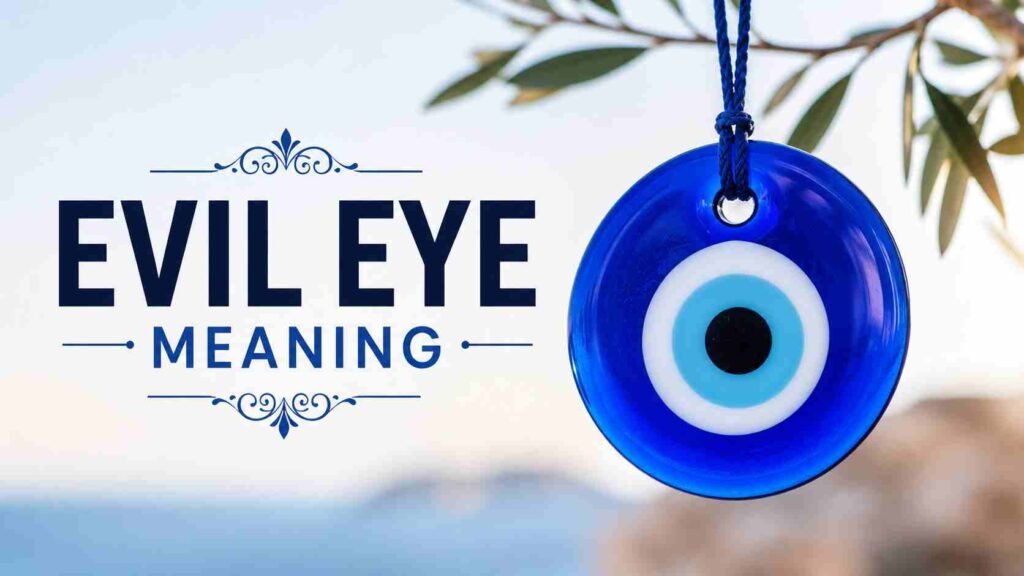
That little blue-and-white eye 🧿 staring back at you from a friend’s bracelet, a doorway in a vacation photo, a tattoo, or all over your Instagram feed.
The evil eye is one of the oldest protective symbols on the planet. At its heart, it stands for two things at once: the belief that a jealous or hateful look can bring you harm, and the charm people wear to bounce that bad energy right back.
This guide walks you through what the evil eye really means, where it came from, how different cultures understand it, what the colors signify, and how to wear it with respect. Let’s get into it.
What Does the Evil Eye Mean?
The evil eye is the belief that an envious or spiteful glance can cause someone bad luck, misfortune, or even physical harm. The famous blue eye symbol is the protection worn to deflect that harmful gaze and send the negativity back where it came from.
Here is the part most people miss.
The harm usually is not intentional. It rarely comes from someone plotting against you. More often, it slips out through plain old envy — an admiring look that carries a little too much longing behind it.
Think about a moment when things were going great for you. A new job, a new relationship, a glow-up. Maybe you felt someone’s eyes on you and something in your gut tightened.
That feeling is exactly what this belief tries to name.
For the spiritually curious, it helps to picture it as an energy exchange. Negative intention travels through a look, and the evil eye acts like a shield that catches it before it lands.
The Evil Eye Curse vs. the Evil Eye Amulet: What’s the Difference?
People mix up three separate ideas all the time, so let’s untangle them cleanly.
The curse is the harmful gaze itself — the envious look and the bad energy it carries.
The symbol is the eye motif you recognize visually, the blue circle with the dot in the middle 🧿.
The amulet is the actual object you wear or hang up to guard against that curse. A bracelet, a pendant, a wall charm.
Here is the beautiful logic behind it all.
To protect yourself from a harmful gaze, you wear a gaze of your own. The amulet does not hide you. It stares right back and says, “I see you seeing me.”
So no, wearing an evil eye does not mean you are carrying a curse around your neck. It means the opposite.
You are carrying protection. The eye you wear is the guardian, not the threat.
The Origins and History of the Evil Eye
This belief is genuinely ancient — older than almost every tradition that carries it today.
Protective eye charms show up in the ancient Near East roughly 5,000 years ago. Mesopotamian texts mention chants to ward off harmful gazes, which tells you people were worried about this long before written history got tidy.
Egypt had its own version too.
The Eye of Horus, the wedjat, belongs to the same big family of protective eyes. Different name, same instinct — an eye that guards and watches over you.
By the time you reach ancient Greece and Rome, the belief was everywhere. Greek writers referenced it centuries before the common era, and even Plato weighed in on how a look might carry harm from one person to another.
The idea also appears across Jewish, Islamic, Hindu, and Buddhist traditions.
What amazes me is how little the core belief has changed in thousands of years. The materials shift, the names shift, but the fear stays the same.
Why did it last so long? Because it names something painfully real.
We all know the discomfort of being envied, and the quiet worry that good fortune might attract resentment. The evil eye gives that feeling a shape — and a way to fight back.
Evil Eye Meaning Across Cultures
The evil eye does not belong to one people or one place. It pops up all over the world, wearing different names and slightly different outfits each time.
Here is a quick comparison to keep it clear:
| Culture | Local Name | How It’s Warded Off |
|---|---|---|
| Greece | mati | Blue glass beads, spoken rituals, household customs |
| Turkey & Near East | nazar / nazar boncuğu | Blue eye beads in doorways, cars, cribs |
| Latin America | mal de ojo | Red charms, azabache (black jet), egg cleansings |
| Italy | malocchio | The cornicello horn charm, blessings against invidia |
| South Asia | drishti / nazar | Kajal dots, chili-and-lime charms, rituals |
| Arabic cultures | nazar | Blue beads, Quran verses |
Let’s bring a few of these to life.
In Greece, the belief is called mati, which simply means “eye.” A Greek grandmother might notice a sudden headache in the family and quietly perform a mati ritual to “remove” the eye — muttering prayers, sometimes dropping oil into water to check if someone got cursed.
The nazar meaning in Turkey runs deep. Walk through Istanbul and you will spot the blue nazar boncuğu everywhere — hanging over shop counters, dangling from rearview mirrors, pinned to babies’ clothes. It is less a statement there and more a habit, a small blue eye kept close out of pure routine.
The mal de ojo meaning in Latin America centers hard on babies and children. Little ones are seen as the most vulnerable, so you will often find a red bracelet or a piece of black jet pinned to an infant to keep admiring glances from doing harm.
In Italy, it is the malocchio, tied tightly to invidia — envy. Instead of the eye, many Italians reach for the cornicello, a small twisted horn charm worn to fend off jealous looks.
South Asia has its own rich take. The tiny black kajal dot smudged onto an Indian baby’s forehead or cheek is not just cute — it is meant to “spoil” the baby’s perfection just enough to deflect envy.
Who Is Most Vulnerable to the Evil Eye?
Across almost every tradition, some people are believed to attract the gaze more than others.
Babies and young children top the list nearly everywhere. Their innocence and cuteness make them magnets for admiration, and admiration can tip into envy fast.
Pregnant women come next.
New life, visible joy, a glowing mom-to-be — all of it draws attention, and attention is exactly what the belief warns about.
Then there is anyone riding a wave of good fortune. A new car. A dream wedding. A promotion. Sudden beauty, wealth, or success.
In some rural traditions, even livestock and prized animals get protective charms.
The logic ties it all together neatly. Good fortune and open happiness attract envy, so the more blessed you look, the more guarding you supposedly need.
If you have ever felt targeted by someone’s jealousy — that prickly sense that a person is rooting against your happiness — this belief speaks directly to that experience.
Evil Eye Protection Rituals Beyond Jewelry
Here is where the topic gets fascinating, because evil eye protection goes way beyond buying a pretty bracelet.
Across the world, people rely on everyday rituals passed down through generations.
Spoken blessings are one of the simplest. In many cultures, when you praise something — a baby, a home, a new haircut — you tack on a phrase like “God bless it” so your compliment does not accidentally carry harm.
Then come the hands-on cleansings.
In Latin American homes, a grandmother might perform a limpia, rolling a raw egg over a child’s body to draw out negative energy. Afterward she cracks the egg into a glass of water and reads the shape to see if the eye took hold.
South Asian families lean on salt, chili, and lime. A common trick involves circling dried red chilies over a person’s head, then burning them — if they smoke without a strong smell, the eye was caught.
The kajal dot shows up again here too, applied to brides and babies alike as a small, deliberate imperfection.
Other traditions hang their protection up where everyone can see it.
Blue beads, red thread, and ribbons get tied onto wrists, cribs, and car mirrors. In Muslim households, Quran verses might be kept close. In Christian homes, holy water, oil, crosses, and prayer do the same job.
You will also see charms mounted in shops, doorways, and kitchens — quiet guardians watching over the whole household.
Evil Eye Color Meanings: Ancient Truth or Modern Myth?
Let’s clear up a big misconception, because this is where a lot of jewelry blogs get it wrong.
Blue is the original color. Full stop.
Blue glass was one of the earliest colored materials in the ancient Mediterranean and Egypt, and blue eyes were rare in the region — which likely gave the color its protective glow. For most of history, blue was the only evil eye color there was.
So where did the rainbow of meanings come from?
Mostly modern jewelry makers. The wider evil eye colors meaning chart is a contemporary layer, not ancient tradition. It is worth knowing, but treat it as a fun guide rather than sacred law.
Here is the popular color reference:
| Color | Commonly Associated Meaning |
|---|---|
| Dark blue | Protection, karma, and fate |
| Light blue | Calm and general protection |
| Red | Courage and protection from fear |
| Green | Balance, success, and freedom from envy |
| Black | Absorbing negativity and inner strength |
| White | Clarity and fresh starts |
| Purple | Removing obstacles and boosting imagination |
| Yellow / gold | Health and energy |
My honest advice? Pick the color that pulls at you.
If a green eye makes you feel grounded, wear green. That personal resonance matters far more than any chart claiming ancient roots it does not actually have.
What Does It Mean When an Evil Eye Breaks or Falls Off?
This is one of the most-asked questions, and the answer is genuinely comforting.
When your evil eye cracks, shatters, or falls off, tradition says it did its job. It absorbed a hit of negativity aimed at you and gave itself up in the process.
So a broken charm is not bad luck.
It is a sign the protection worked. The eye took the blow so you did not have to.
This comes up most with the evil eye bracelet meaning, since bracelets get the most wear and tear. If your evil eye bracelet snaps one day, the customary response is simple.
Thank it, let it go, and get a new one to keep the protection going.
Is the Evil Eye Religious, Spiritual, or Just Fashion?
Honestly? It can be all three, depending on who is wearing it.
For some people, it is heritage — a living link to their family, their grandmother, their homeland. Wearing it keeps a cultural thread alive.
For others, it is spiritual belief.
They genuinely trust in energy, protection, and the idea that intention travels between people. The spiritual meaning of the evil eye is central to how they move through the world.
And for plenty of folks, it is simply fashion. They love how it looks, and that is a perfectly valid reason too.
Here is the honest tension worth naming.
Mass-market jewelry has turned the symbol into a trend, and that has diluted some of its original weight. A charm that once carried deep meaning now shows up on fast-fashion racks by the thousand.
It also helps to know the evil eye is not tied to a single religion. It appears within many faiths without belonging to any one of them.
If you wear it purely for style, no shame in that — but understanding its roots only makes it more meaningful.
Can Anyone Wear the Evil Eye Respectfully?
Yes. People from countless backgrounds and faiths have worn it for thousands of years, and no tradition locks it behind a door.
That said, a little awareness goes a long way.
The meaning shifts from culture to culture and even from family to family. Wearing it with some understanding of where it comes from shows respect for the people who kept the belief alive.
So do a little learning. Honor its roots. Skip the mindset that treats it as a throwaway trend you toss out next season.
There is also a common custom worth knowing: many people wear the evil eye on the left side, closest to the heart, since that is seen as the personal, receiving side of the body.
If you are eyeing an evil eye necklace, bracelet, or tattoo, you can absolutely wear it thoughtfully. Intention is everything.
Evil Eye vs. Hamsa: What’s the Difference?
These two get paired so often that people assume they are the same thing. They are not — though they make a great team.
The Hamsa is the open-hand symbol, known as the Hand of Fatima in Muslim tradition and the Hand of Miriam in Jewish tradition. It protects through the gesture of an open, warding palm.
The evil eye, meanwhile, protects through the returning gaze.
So the evil eye vs hamsa difference comes down to form. One guards with a hand that pushes harm away, the other guards with an eye that stares harm down.
You will often see them combined, with a single eye set right in the center of the Hamsa’s palm.
Wearing both together is believed to double your protection — the hand and the eye working side by side, guarding you on two fronts at once.
Why the Evil Eye Still Matters Today
Five thousand years is a long time for any symbol to survive. The evil eye has outlasted empires, religions, and countless trends.
Why does it stick around?
Because it speaks to something we still feel. Envy, comparison, and the quiet wish to protect what we love have not gone anywhere.
At its core, the belief is a gentle social reminder.
Stay humble. Bless what you praise. Guard the things and people that matter most to you.
Scroll through social media for two minutes and you will feel the modern version of this ancient anxiety — the comparison, the envy, the sense of being watched. The evil eye simply gives that feeling a face and a small, steady answer.
Not a wall. Just a look held steady, watching back on your behalf.
Evil Eye Meaning FAQs
What does the evil eye mean?
The evil eye refers to a harmful, envious look believed to bring bad luck or misfortune. It also names the protective charm worn to deflect that gaze — an eye that watches back. It is one of the oldest protection symbols in the world.
Is the evil eye good or bad luck?
The charm itself is good luck. It is protective, meant to guard you from negativity. The “bad luck” is the harmful gaze it defends against, not the amulet you wear.
What do the different evil eye colors mean?
Blue is the traditional color, tied to broad protection. Other colors — red for courage, green for balance, black for absorbing negativity — carry mostly modern meanings created by jewelry makers, not ancient tradition. Choose the one that resonates with you.
What does it mean when an evil eye bracelet breaks?
A broken evil eye is seen as protection working, not bad luck. The charm absorbed negativity aimed at you and gave itself up. The custom is to thank it and replace it with a new one.
Which side should you wear the evil eye on?
Many people wear it on the left side, closest to the heart, since that is considered the personal or receiving side of the body. There is no strict rule, though — comfort and preference are perfectly fine guides.
Can anyone wear the evil eye?
Yes. No tradition restricts its use, and people across many cultures and faiths wear it. Wearing it with awareness of its roots keeps the practice respectful and meaningful.
What’s the difference between the evil eye and the Hamsa?
The evil eye is an eye-shaped symbol that guards through a returning gaze. The Hamsa is an open-hand symbol that guards through a warding palm. They are often paired, with an eye placed in the center of the hand for double protection.
What does the 🧿 emoji mean?
The 🧿 emoji represents the classic blue nazar bead. People use it to signal protection, to ward off jealousy or bad vibes, or simply to add a spiritual touch to a post about good fortune.