
You just got a text that says “PMO” and now you’re stuck.
Are they annoyed at you? Are they asking for something? Do you just… reply with a thumbs up and hope for the best?
Here’s the thing — PMO is one of those slang terms that has two completely opposite meanings. One is friendly. One is frustrated. And if you mix them up, your reply can come off as tone-deaf really fast.
This guide will show you exactly how to tell them apart — using the sentence structure, the emotional tone of the message, and the platform it came from.
By the end, you’ll be able to decode any PMO you see in about five seconds.
What Does PMO Mean? The Two Main Definitions
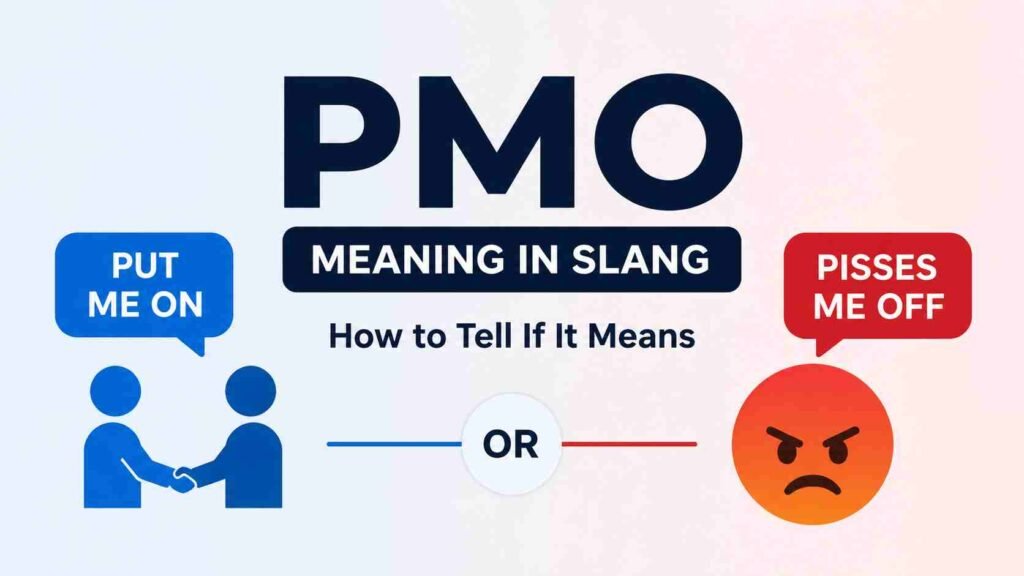
PMO stands for one of two things: “Put Me On” or “Pisses Me Off.”
That’s it. Those are the two meanings that matter for 99% of everyday texting and social media use.
“Put Me On” is the social, curious one.
It’s how people ask for a recommendation, an introduction, or insider knowledge about something they haven’t discovered yet. Think of it as a more casual way of saying “hook me up” or “show me something good.”
Real example: “PMO to some good underground rappers” = please recommend me some artists I haven’t heard.
Another one: “PMO to whoever does your hair” = connect me with your stylist.
It’s a warm, social request. There’s no frustration behind it at all.
“Pisses Me Off” is the venting one.
People drop this when something is irritating them and they want to express it quickly without typing out the full phrase.
Real example: “This wifi PMO today” = this wifi is driving me crazy.
Another one: “People who are always late PMO fr” = that genuinely frustrates me.
It’s short, punchy, and usually comes with a little drama for emphasis.
Neither version is more “correct” than the other. They’re both valid — they just carry completely different energy, and reading that energy is the key to getting it right.
How to Tell Which Meaning Is Intended
Good news: you don’t have to guess. The sentence almost always tells you exactly which meaning someone intended.
Use this three-step decoder.
Step 1: Look at what comes after PMO.
If PMO is followed by “to” — as in “PMO to” — it’s almost certainly “Put Me On.” They’re asking you to introduce them to something.
“PMO to your playlist” = recommendation request. Easy.
If PMO comes after a thing, a situation, or a complaint, it’s “Pisses Me Off.”
“This long line PMO” = they’re annoyed. No request happening here.
Step 2: Read the emotional tone of the whole message.
Does the message feel open and curious, or irritated and reactive?
A message like “omg you listen to that artist too?? PMO to more like them” is excited and friendly.
A message like “my professor PMO with these surprise quizzes” is clearly frustrated.
The tone of the full message is usually obvious once you read it as a whole.
Step 3: Think about where you saw it.
Different platforms lean toward different meanings — and that context alone can point you in the right direction before you even read the full sentence.
More on that in the next section.
Common Sentence Patterns for Each Meaning
Once you recognize these patterns, PMO becomes incredibly easy to read.
“Put Me On” almost always shows up as:
- “PMO to some good [music/shows/brands/food spots]”
- “Can you PMO to…”
- “PMO to your [routine/playlist/fave brand]”
- “Someone PMO please”
- “You gotta PMO, what are you listening to?”
“Pisses Me Off” almost always shows up as:
- “This [thing] PMO so much”
- “It really PMO when people [do something annoying]”
- “[Situation] PMO, no cap”
- “PMO fr” (for real)
- “Why does this PMO every single time”
Here’s a side-by-side comparison so the difference clicks immediately:
| Example Sentence | What It Means |
|---|---|
| “PMO to some good underground rappers” | Put Me On |
| “Bad customer service PMO” | Pisses Me Off |
| “Can you PMO to that skincare brand?” | Put Me On |
| “When people chew loudly it PMO” | Pisses Me Off |
| “PMO to your playlist, that song was fire” | Put Me On |
| “This wifi PMO every single day” | Pisses Me Off |
See the pattern? PMO followed by “to” = request. PMO after a complaint = frustration. That one rule alone will get you the right answer most of the time.
Platform-by-Platform Breakdown
Where you see PMO is one of your biggest clues. Each platform has its own vibe, and that vibe shapes how people use this term.
TikTok — leans “Put Me On”
TikTok comment sections are built for discovery. People are always asking creators to share their sources, their music, their products, their settings.
“PMO to that transition effect” and “PMO to the song in this video” are basically native TikTok language.
X (Twitter) — leans “Pisses Me Off”
Twitter is where people go to vent. Short, punchy, reactive posts dominate — which makes “Pisses Me Off” the more common meaning here.
“People who don’t use their turn signal PMO every time” fits the Twitter energy perfectly.
Instagram — both meanings
Instagram DMs and story replies often carry “Put Me On” energy — “PMO to where you got that jacket” is a classic IG DM.
But in captions and vent posts, the frustrated meaning shows up just as often. Read the full caption to know which one you’re dealing with.
Snapchat — leans “Put Me On”
Snap is casual and friend-to-friend, which makes it a natural home for recommendation requests.
“I’m bored, PMO to a new show” is a very standard Snap message between friends.
Discord — both meanings
Discord context depends entirely on the server and the channel. Gaming communities drop “PMO to a good build for this map” in one message and “this server lag PMO so bad” in the next.
Read the server topic and the chat history — that’ll tell you everything.
The Risk of Getting It Wrong
Misreading PMO doesn’t just cause confusion — it can make your reply feel completely off.
Picture this: your friend vents “this group project PMO, nobody does their part” and you respond “omg same, have you tried using Notion to organize everyone?”
You just gave productivity advice to someone who wanted to vent. Not a great look.
Flip it: someone texts “PMO to your study playlist” and you reply “ugh I know, it’s the worst 😩”
Now you look like you had no idea what they were even saying.
Here’s the quick rule of thumb:
If the message has a positive, curious, or social vibe → it’s “Put Me On.”
If it sounds frustrated, annoyed, or reactive → it’s “Pisses Me Off.”
And if you genuinely can’t tell? Just ask.
A quick “wait, put you on to what?” or “lol what happened?” clears it up in one message — no embarrassment required.
Other Meanings of PMO You Should Know
There are a couple of other definitions floating around, and it’s worth knowing they exist.
Project Management Office is the formal, professional meaning.
In corporate settings, PMO refers to a department that standardizes project processes and keeps teams aligned. You’d see it in a work email, a LinkedIn post, or a business presentation — almost never in a group chat.
If someone texts you “PMO” out of nowhere and you work together, context will make it obvious. But in casual digital spaces, this meaning basically never applies.
There’s also a niche adult/self-improvement meaning that circulates in certain online forums and communities. It exists, and you may come across it in specific corners of the internet.
But in mainstream social media — TikTok, Instagram, Snapchat, Discord, X — this meaning is not what’s being used. Don’t let it confuse you.
For everyday texting and social media, it’s always one of two things: “Put Me On” or “Pisses Me Off.”
Quick-Reference Summary
Here’s everything condensed into one scannable cheat sheet.
| Meaning | Vibe | Common Platforms | Key Signal |
|---|---|---|---|
| Put Me On | Friendly, curious, social | TikTok, Snapchat, IG DMs | “PMO to [something]” |
| Pisses Me Off | Frustrated, reactive, venting | X/Twitter, rant posts | “[Thing/situation] PMO” |
| Project Management Office | Formal, professional | Work emails, LinkedIn | Business context only |
The one rule to remember:
If PMO is followed by “to,” they want a recommendation.
If PMO comes after a complaint or a situation, they’re annoyed.
That’s really all there is to it. Keep that decoder in your back pocket and you’ll never stare at a confusing “PMO” text wondering what to say again.