
Take a look at your open palm right now.
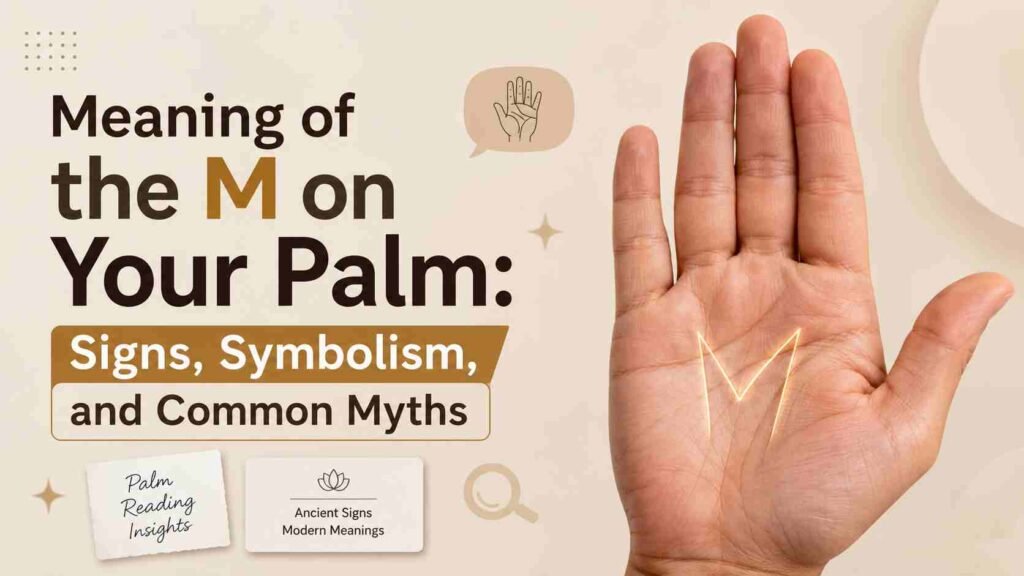
If the lines across your hand form a rough letter “M,” you’ve probably wondered what it means.
You’re not alone. The hidden meaning of the M on your palm is one of the most searched questions in palmistry, and there’s a good reason for that.
The mark looks personal, almost like a signature written into your skin.
This guide walks you through what the M actually means, how to tell if you truly have one, and which popular claims you can safely ignore.
Let’s start with the short answer.
What Does the M on Your Palm Mean?
The M is a shape formed where several major lines on your palm meet and cross.
In palmistry — the practice of reading a person’s character and tendencies from the lines on their hands — the M is traditionally linked to three qualities: strong intuition, self-discipline, and sharp discernment.
In plain terms, people with a clear M are often seen as good at trusting their gut, sticking to their goals, and reading situations accurately.
That sounds flattering, and it’s meant to.
But here’s the honest part most articles skip: the M is a symbol, not a scientific predictor.
It won’t tell you your future or guarantee your bank balance. What it can do is give you a starting point for reflection.
Throughout this guide, you’ll learn the tradition behind the M, how to spot a real one, and where the internet has stretched the truth.
How to Tell If You Really Have an M on Your Palm
Before you read anything into the M, you need to confirm you actually have one.
This is where most people get tripped up. Once you start looking for an M, you can convince yourself it’s on every hand you see.
The M usually forms from three main lines:
- Heart line: the top horizontal line running under your fingers
- Head line: the line crossing the middle of your palm
- Life line: the curved line wrapping around the base of your thumb
Sometimes a fourth line, the fate line, joins in and strengthens the shape.
When these lines connect at the right angles, they create two peaks and a dip in the middle — the letter M.
So how do you know if yours counts?
A clear M has connected lines, visible depth, and a shape you can spot without squinting. A faint M has shallow, patchy lines that only look like an M if you tilt your hand just right.
Here’s a simple decision rule:
- For a clear, connected M, treat it as present.
- If the shape is faint or broken, read it as weak or partial.
- When in doubt, compare both hands in natural daylight.
One quick warning. Don’t confuse the M with the Simian line, a single crease that replaces the separate heart and head lines entirely.
The two are different markings with different meanings, and mixing them up is a common mistake.
The Lines That Create the M (and What Each One Represents)
To understand your M, it helps to know the lines behind it.
Think of each line as telling one part of your story. The M borrows meaning from all of them at once.
Your heart line covers emotions, relationships, and how you connect with others.
A deep, clear heart line often points to someone who feels things strongly and cares openly. If yours curves upward toward your fingers, palmists read it as a warm, expressive nature.
Your head line reflects how you think, focus, and make decisions.
A long, straight head line suggests a logical, step-by-step thinker. A wavy one leans toward creativity and jumping between ideas.
Your life line maps your energy, vitality, and general direction in life.
Contrary to a stubborn myth, it does not predict how long you’ll live. It says more about the quality and pace of your days than the number of them.
The fate line, when present, points to your career path and the outside forces that shape it.
Not everyone has a strong one, and that’s completely normal.
When these lines cross in the right pattern, the M appears. That’s why the M is read as a blend of heart, mind, and life energy working together.
The Hidden Meaning of the M in Palmistry
Now for the part you came here for.
Traditionally, the M carries four core meanings. Read these as tendencies to reflect on, not fixed facts about who you are.
Strong intuition. People with an M are said to pick up on things before they’re spelled out.
You probably know someone like this. Maybe a friend who texts “are you okay?” the exact moment your day falls apart, before you’ve said a word. That’s the kind of quiet radar the M is linked to.
Self-discipline and drive. The M is tied to staying the course when others give up.
This isn’t about never getting tired. It’s about finishing the project, keeping the promise, and grinding through the boring middle stretch of a goal.
Discernment. This means reading people and situations accurately.
Think of the coworker who spots a bad deal before anyone else does, or the friend who says “I don’t trust this person” and turns out right months later.
A balance of logic and emotion. Because both the head line and heart line feed into the M, palmists read it as a sign of someone who weighs facts and feelings together.
You make decisions with your head, but you don’t ignore your gut.
Do these describe you perfectly? Maybe, maybe not.
Treat them as prompts for honest self-reflection rather than a personality verdict.
M on the Left Hand vs Right Hand vs Both Hands
Which hand carries the M changes how you read it.
In palmistry, your two hands tell slightly different stories:
- Your non-dominant hand (the one you don’t write with) reflects your inner nature and natural potential.
- Your dominant hand (the one you write with) reflects the traits you’ve actually developed and how you show up in daily life.
So the placement of your M matters. Here’s a simple breakdown:
| Where the M appears | What it traditionally suggests |
|---|---|
| Non-dominant hand only | Natural gifts you were born with but may not fully use yet |
| Dominant hand only | Traits you’ve built and put into action over time |
| Both hands | Strong alignment between who you are inside and how you act outside |
| Neither hand | Your strengths simply show up in other markings — no cause for worry |
An M on both hands is often treated as the most striking version.
It suggests your inner self and outer life are pulling in the same direction. What you feel matches what you do.
If your M sits only on one hand, that’s still meaningful. It just tells a more specific part of your story.
What Changes the Meaning of Your M
Here’s the nuance almost every article online leaves out.
In palmistry, the quality of the lines matters far more than simply spotting the letter. Two people can both have an M and read completely differently.
Look closely at your lines and note these details:
- Deep, clear lines suggest stronger, well-established traits.
- Faint lines suggest the same tendencies, just softer and less pronounced.
- Broken or chained lines (lines that stop and start, or look like tiny links) point to interruptions or inconsistency in that area of life.
- Forked or crossed lines near the M add extra influences that a reader would factor in.
Some people also spot a double M, where the shape appears twice or looks doubled on one hand.
Fans of the double M read it as an amplified version of the usual traits. There’s no official rulebook here, so take it as folklore rather than fact.
The takeaway is simple. Don’t just ask “do I have an M?” Ask “what condition is my M in?”
That single shift will make your reading far more accurate and honest.
Spiritual Meaning vs Symbolic Meaning of the M
The M speaks to two very different kinds of readers, so let’s serve both.
If you lean spiritual, the M is often read as a sign of heightened intuition, deeper self-awareness, and a strong sense of purpose.
Many people see it as a nudge to trust their inner voice and pay attention to patterns and synchronicities around them.
If you lean skeptical, the M works better as a symbolic prompt.
It’s not predicting anything. It’s simply a striking mark that invites you to pause and reflect on your habits, strengths, and choices.
Both readings can coexist. You don’t have to pick a side.
Why does the M feel so personal to almost everyone?
Because it looks written into your hand. We’re wired to notice patterns, and a letter that seems stamped onto our own palm feels like a message meant just for us.
Hold the meaning lightly. Use it as a mirror for self-inquiry, not a fortune carved in stone.
Common Myths About the M on Your Palm
The M attracts a lot of exaggerated claims online.
Here’s what palmistry tradition actually says versus what the internet has added on top.
Myth: The M guarantees wealth.
Reality: The M is linked to traits like discipline and discernment, not to a specific bank balance. Habits and choices build wealth — not a line on your hand.
Myth: The M proves you’re psychic.
Reality: Intuition is a tendency to notice subtle cues, not a supernatural power. Sensing that a friend is upset is emotional awareness, not mind reading.
Myth: Almost no one has the M.
Reality: Frequency claims online contradict each other wildly, which we’ll unpack next. The M is more common than the “ultra-rare” headlines suggest.
Myth: No M means bad luck.
Reality: Every palm carries meaning through different markings. A hand without an M simply tells its story through other lines and shapes.
If a source promises the M will make you rich, famous, or psychic, close the tab.
Real palmistry is about tendencies and self-reflection, not guarantees.
Is the M on Your Palm Actually Rare?
You’ll see confident but conflicting numbers all over the web.
Some articles claim the M appears in only 1–2% of people. Others put it at 30–40%. That’s an enormous gap, and it should make you skeptical of both.
Here’s the honest explanation.
There is no standardized, scientific way to measure how many people have an M. Palmistry is a symbolic tradition, not a field with peer-reviewed data.
Most rarity claims are anecdotal or passed down through tradition, then repeated online until they sound official.
So what’s the truthful takeaway?
Once you know what a real M looks like, you’ll notice it’s fairly common. And that’s fine — rarity was never what gave the M its meaning in the first place.
Focus on what your M might reveal about you, not on how special the shape supposedly is.
A Short History of the M and Palm Reading
The M didn’t appear out of nowhere. It grew from centuries of palm reading traditions.
Palmistry has deep roots in India, where it’s part of Samudrika Shastra, an ancient system that reads the body — including the hands — for insight into character and destiny.
From there, palm reading spread across Asia, the Middle East, and eventually into Europe.
Western palmistry developed its own vocabulary, naming the heart line, head line, life line, and the mounts of the palm.
Interpretations shifted from culture to culture, which is part of why you’ll find different meanings for the same marking depending on where you look.
The M as a standalone “special sign,” though, is largely a modern spotlight.
Classical palmistry focused on individual lines and their quality. The idea of hunting for a hidden letter took off more recently, boosted heavily by social media and online spirituality.
Knowing this history helps you read the M with clear eyes. It’s a genuine part of palmistry — just amplified by the internet age.
How to Read the M on Your Own Palm, Step by Step
Ready to check your own hand? Here’s a simple, reliable method.
Follow these steps in order:
- Find good light. Sit near a window and open your palm in natural daylight, fingers slightly spread.
- Start with your dominant hand. This shows the traits you’ve actively developed, so it’s the best place to begin.
- Compare your other hand. Look at your non-dominant palm next to see your natural, inherited side.
- Study the shape. Note whether the M is clear or faint, deep or shallow, and whether any lines are broken or crossed.
- Check for nearby markings. Small crosses, stars, or forks near the M can shade its meaning.
Once you’ve spotted your M, sit with these reflection questions:
- Do you tend to trust your gut, even when logic argues otherwise?
- Do you often end up leading or organizing without meaning to?
- Do you notice patterns and details other people miss?
- Do you balance your emotions and your reasoning well?
Picture the friend who always becomes the group trip planner without anyone asking. That quiet, natural organizing instinct is exactly the kind of trait the M points toward.
Here’s the most important step. Never read the M in isolation.
Read it alongside the rest of your palm, and your interpretation will be far more accurate.
What If You Don’t Have an M on Your Palm?
No M? You’ve lost nothing.
Let’s clear this up directly, because a lot of online content quietly implies the opposite.
Not having an M is not a curse, a bad omen, or a sign of a limited life. It simply means your strengths show up through other parts of your hand.
Palmistry is full of meaningful markings beyond the M:
- Crosses can point to important turning points or protection.
- Triangles are often read as signs of talent or sharp thinking.
- Stars are linked to sudden events or bursts of energy.
The whole point of palm reading isn’t to rank hands from best to worst.
It’s a tool for self-awareness. Your palm is a prompt to think about your habits, strengths, and choices — and every hand has plenty to offer.
If you don’t have an M, explore what your dominant lines and mounts reveal instead. You may find something that fits you even better.
FAQs
Is the M on the palm lucky?
Tradition often links the M to good fortune, but “luck” here really means helpful traits like discipline and intuition. Those tendencies can create opportunities, but the M itself doesn’t hand you luck.
Does the M on the palm mean wealth?
Not directly. The M is tied to qualities that can support success, such as drive and good judgment. Wealth still comes from your choices and effort, not the line itself.
Is the M different for women and men?
Some traditions claim the M is stronger or more common in women, but there’s no reliable evidence for this. Read your M the same way regardless of gender.
Can the M shape change over time?
Minor lines can shift, deepen, or fade over the years, so a faint M might become clearer or vice versa. Major lines tend to stay fairly stable throughout life.