
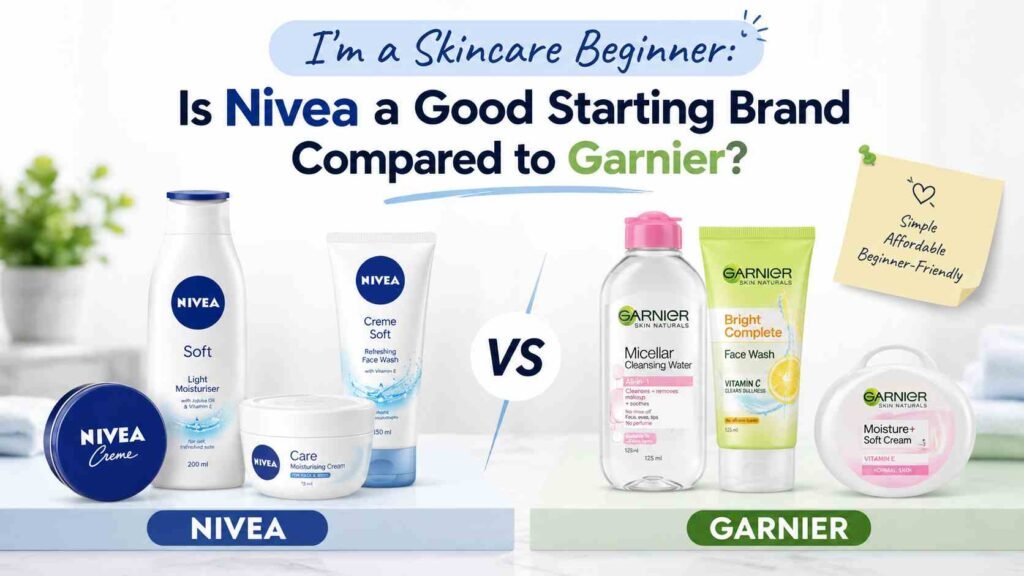

You are standing in the skincare aisle. There are a hundred bottles, ten promises on each label, and two names you keep hearing about: Nivea and Garnier.
Both are cheap. Both are everywhere. And you just want to know which one to grab so you can go home and start.
Here is what you will get from this guide: a straight answer, a simple way to choose based on your own skin, and a starter routine you can begin tonight.
No jargon. No ten-step routine. Just the parts that matter for a beginner.
Let’s sort it out.
The Short Answer: Nivea vs Garnier for Beginners
Both Nivea and Garnier are good starting brands. The better one for you depends on your skin, not the logo on the bottle.
Here is the quick split. Nivea leans toward simple, rich hydration. Garnier leans toward lighter formulas and easy cleansing, like its famous micellar water.
But here is the honest part most articles skip: the exact product matters more than the brand name. A “good brand” can still sell one cream that breaks you out.
So use this as your fast first filter. If your skin feels dry and tight, lean Nivea. If your skin gets oily and shiny, lean Garnier.
That is enough to point you in the right direction. Keep reading to find your exact match.
Read Also: Are Nivea Products Safe During Pregnancy Compared to Burt’s Bees and Mustela?

How to Choose a First Skincare Brand (A Simple Decision Framework)
You choose skincare by skin need first, then by brand second. Get that order right and the rest is easy.
You do not need to memorize ingredients to do this. In the same way you do not need to know how an engine works to know your car needs fuel, you only need to notice how your skin behaves.
Ask yourself these three questions.
1. How does your skin feel right after you wash it?
Imagine washing your face and it feels tight, like dry paper stretched over your cheeks. That tight feeling means your skin wants richer moisture, which points you toward Nivea.
If it feels fine and comfortable, you have more freedom to choose either brand.
2. How shiny are you by midday?
Press a tissue to your forehead and nose around lunchtime. If it comes away greasy or your skin looks like a mirror, you have oily skin, and lightweight formulas will feel better. That points you toward Garnier.
3. Does new stuff often sting or turn you red?
If new products regularly burn, itch, or leave red patches, your skin is sensitive. Neither brand automatically wins here, so you should hunt for fragrance-free formulas and always patch test.
Now the reassuring part. You only need three products to start: a cleanser, a moisturizer, and a sunscreen. Not ten.
Write down your answers to those three questions before you shop. That single note will save you from buying the wrong thing.
Nivea vs Garnier by Skin Type
Your skin type is the biggest clue. Let’s break it down by the categories beginners actually search for.
Dry skin
Dry skin drinks up moisture and still wants more. Nivea’s richer creams usually feel more comfortable here because they sit on the skin longer and stop that tight, flaky feeling.
Look for a cream or lotion that feels cushiony, not watery. If your skin still feels tight after moisturizing, you need something richer.
Oily skin
Oily skin already makes plenty of its own oil, so heavy creams can feel like a greasy layer. Garnier’s lighter cleansers and gel-style moisturizers often sit better and feel fresher.
One warning: oily skin still needs moisturizer. Skipping it can make your skin produce even more oil to compensate.
Combination skin
Combination skin is oily in some spots, usually the forehead, nose, and chin, and dry in others, like the cheeks. The trick is to match the product weight to each area.
You can use a lighter Garnier moisturizer over the oily zones and a richer Nivea cream on the dry patches. Mixing brands here is smart, not confusing.
Sensitive skin
Sensitive skin reacts easily, so no brand gets an automatic pass. A popular product can still leave you red and itchy.
Reach for fragrance-free formulas from either brand, and always patch test before you put anything on your full face. Comfort beats popularity every time.
Here is a simple way to find your row.
| Your skin type | Lean toward | What to look for |
|---|---|---|
| Dry | Nivea | Rich cream, cushiony feel |
| Oily | Garnier | Lightweight gel or lotion |
| Combination | Mix both | Light on oily zones, rich on dry ones |
| Sensitive | Either, carefully | Fragrance-free, patch tested |
Find your row, note the direction, and move on to picking actual products.
Nivea vs Garnier by Product: Cleanser, Moisturizer, and Micellar Water
Brand talk only gets you so far. Let’s move to the three products you will actually buy first.
First cleanser
A cleanser removes dirt, oil, and grime from your face. That is its whole job.
Nivea offers gentle, cream-style washes that suit dry skin because they clean without stripping. Garnier’s foaming face washes feel deeper-cleaning and suit oily skin that wants that “squeaky fresh” result.
Which to buy first: Dry skin, pick a gentle Nivea wash. Oily skin, pick a Garnier face wash made for oily or combination skin.
First moisturizer
A moisturizer keeps water in your skin so it stays soft and comfortable. Every skin type needs one, even oily skin.
Nivea’s moisturizers focus on hydration and tend to feel richer, which dry skin loves. Garnier’s options are usually lighter and absorb fast, which oily skin prefers.
Which to buy first: Match the weight to your skin. Tight and dry, go rich. Shiny and oily, go light.
First micellar water
Micellar water is a no-rinse liquid that lifts off makeup and grime with a cotton pad. Think of it as a gentle, low-effort way to wipe the day off your face.
Garnier’s micellar water is a beginner favorite because it works well and costs little. One honest caveat: it does not replace a full cleanse if you wear heavy makeup or sunscreen. Use it first, then follow with your face wash.
Which to buy first: If you wear makeup, buy this early. If you do not, you can skip it for now.
Here is the quick view.
| Product | Nivea style | Garnier style | Better for |
|---|---|---|---|
| Cleanser | Gentle, creamy | Foaming, deep-clean | Nivea: dry / Garnier: oily |
| Moisturizer | Rich, hydrating | Light, fast-absorbing | Nivea: dry / Garnier: oily |
| Micellar water | Limited focus | Strong, low-cost | Garnier: makeup removal |
Pick one product from each row that matches your skin. That is your shopping list.
Common Mistakes Beginners Make (and How to Avoid Them)
Most beginner skin problems come from a handful of habits. Name them now and you avoid weeks of frustration.
Choosing by hype instead of your skin. A viral video shows a product on someone whose skin is nothing like yours. Fix: choose by your own skin need, using the three questions above.
Buying too many products at once. When you start five things together and your skin reacts, you have no idea which one caused it. Fix: add one new product at a time and give it a week or two.
Starting strong actives too early. Beginners often grab acids and vitamin C serums before they even have a basic routine. Fix: master cleanser, moisturizer, and sunscreen first, then add extras later.
Using a heavy cream on breakout-prone skin. A rich cream is great for dry skin but can feel suffocating on oily or acne-prone skin, even if everyone online loves it. Fix: match texture to your skin, not to the reviews.
Skipping sunscreen. People obsess over moisturizer and forget the one product that protects skin the most. Fix: apply a broad-spectrum SPF 30 or higher every morning, rain or shine.
Read that list once more and pick the one mistake you are most likely to make. Then decide right now to skip it.
When Neither Nivea nor Garnier Is the Right Starting Point
Sometimes a drugstore basic is not enough, and that is worth saying plainly. Your skin might need more targeted care.
Watch for these flags:
- Ongoing eczema with cracking or persistent flaking
- Rosacea, meaning regular flushing and stubborn redness
- Painful, deep, or scarring acne
- Products that keep causing reactions no matter what you try
If any of these sound like you, look for fragrance-free, dermatologist-recommended basics, or talk to a professional. A dermatologist can save you months of guessing.
Needing something beyond Nivea or Garnier is not a failure. It just means your skin needs a better-suited tool, the same way some feet need a specific shoe.
One plain caveat: this article is general guidance, not medical advice. For anything painful or persistent, see a professional.
If you spotted your skin in that list, book a consultation before you buy anything else.
Sample Beginner Routines by Scenario
Here are five ready-to-use routines. Find the one that sounds like you and follow the steps.
“I want the simplest routine possible”
Morning:
- Rinse your face or use a gentle cleanser.
- Apply a moisturizer for your skin type.
- Apply sunscreen.
Evening:
- Cleanse your face.
- Apply the same moisturizer.
“I’m dry and tight”
Morning:
- Wash with a gentle Nivea cream cleanser.
- Apply a rich Nivea moisturizer.
- Apply sunscreen.
Evening:
- Cleanse with the same gentle wash.
- Apply the rich moisturizer again.
“I’m oily and shiny”
Morning:
- Wash with a Garnier face wash for oily skin.
- Apply a lightweight Garnier moisturizer.
- Apply an oil-free sunscreen.
Evening:
- Cleanse with the same face wash.
- Apply the lightweight moisturizer.
“I wear makeup daily”
Morning:
- Rinse or cleanse gently.
- Apply a moisturizer for your skin type.
- Apply sunscreen.
Evening:
- Wipe off makeup with Garnier micellar water.
- Follow with your face wash for a full clean.
- Apply your moisturizer.
“I’m on a tight budget”
Morning:
- Wash with one affordable cleanser.
- Apply one affordable moisturizer.
- Apply one affordable sunscreen.
Evening:
- Cleanse with the same wash.
- Apply the same moisturizer.
Three products cover it. You do not need more to start.
Pick your scenario and buy only what its steps list. Ignore everything else for now.
Final Verdict: Should You Start With Nivea or Garnier?
There is no single winner, only the right fit for you. Both brands can start a beginner off well.
Here is the quick rule. Dry or sensitive skin leans Nivea. Oily skin or targeted cleansing leans Garnier. Mixing both is completely fine.
Remember that consistency beats product count. A simple three-step routine you actually follow every day will do more than a fancy shelf of bottles you use twice.
Set realistic expectations too. Give any routine a few weeks before you judge it, because skin needs time to adjust. This is not a guarantee, just how skin usually works.
Now do one thing: pick your three starter products and start tonight.
FAQ
Is Nivea or Garnier better for beginners?
Neither is better across the board. Nivea suits dry and sensitive skin with its richer, simple formulas, while Garnier suits oily skin and easy makeup removal. Choose by your skin type, not the brand name.
Can I use Nivea and Garnier together?
Yes. You can cleanse with one brand and moisturize with the other with no problem. Many beginners do exactly this, for example using Garnier micellar water and a Nivea moisturizer. Products work by what they do, not by matching logos.
Which is better for oily skin?
Garnier usually wins for oily skin. Its lighter cleansers and fast-absorbing moisturizers feel fresher and less heavy. Just remember that oily skin still needs a moisturizer, so do not skip it.
Do beginners need a serum?
No. Start with a cleanser, a moisturizer, and a sunscreen. Once that routine feels comfortable and you have a specific concern, you can add one serum at a time. Introduce it slowly so you can tell how your skin reacts.