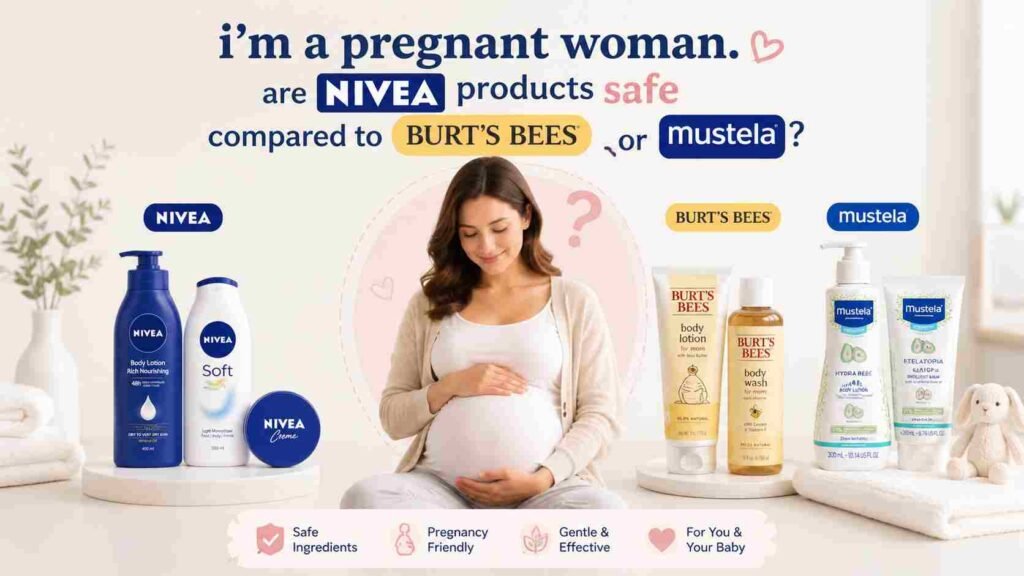

You are pregnant, standing in a store aisle, holding a bottle of Nivea and wondering if it is still okay to use.
Here is the honest answer: no brand is automatically safe or automatically unsafe. The specific product and its ingredient list decide.
So if you have been asking, “I’m a pregnant woman — are Nivea products safe compared to Burt’s Bees or Mustela?” the real answer is not a brand name. It is a habit of checking.
Good news for first-time mothers: you do not need to throw out everything you own and start over. Most of what is in your bathroom is probably fine after a quick look.
One quick note before we start. This is general information, not medical advice. Confirm anything new with your OB-GYN or midwife, especially in your first trimester.
Now let’s make this simple.
The Short Answer for Busy Moms
None of these three brands is a blanket “yes” or a blanket “no.” Not Nivea. Not Burt’s Bees. Not Mustela.
Each one sells simple moisturizers you can use daily. Each one also sells stronger products that deserve a closer look.
So the rule is this: check the label, not the logo.
A brand name tells you almost nothing about whether one specific bottle is right for pregnancy. The ingredient list tells you everything.
This article gives you a repeatable way to judge any product from any of these three brands. Once you learn it, you can check a fourth or fifth brand just as easily.
One honest caveat: no cream can guarantee a specific outcome, and every pregnancy is different. What suits your friend’s skin may not suit yours.
Read the next section before your next shopping trip. It takes two minutes and saves a lot of second-guessing.
Read Also: La Roche-Posay vs Neutrogena for Acne: A College Student’s Product-by-Product Guide
Why “Is This Brand Safe?” Is the Wrong Question
A brand name is a shortcut. And shortcuts hide detail.
When you ask “Is Nivea safe?” you are treating dozens of very different products as if they were one thing. They are not.
Judging a brand by one product is like judging a restaurant by one dish. The menu is much bigger than that.
Nivea makes a plain moisturizing cream. It also makes anti-aging formulas and sunscreens. Those do not deserve the same answer.
Instead of asking about the brand, ask four questions about the actual product in your hand:
- What is this product for — moisturizing, cleansing, protecting, or treating?
- Does it contain a flagged ingredient?
- Does it stay on your skin, or does it rinse off?
- Are you using it on one small spot, or across your whole body every day?
Once you can answer these four, the brand name matters far less.
A simple Nivea moisturizer and a Mustela body balm might land in the exact same place: easy, plain, low-risk. Meanwhile a treatment product from a “natural” brand might need more caution than either.
Keep these four questions in your notes app. Pull them up next time you are standing in the skincare aisle.
How to Check Any Pregnancy Skincare Product in 30 Seconds
You do not need a chemistry degree to check a product. You need a short routine you can run in half a minute.
Here it is, one action per step:
- Flip the product over and find the ingredient list.
- Scan for the flagged words in the next section.
- Note whether it is a leave-on or a rinse-off product.
- Check whether it is for a small area or full-body daily use.
- If anything gives you pause, set it aside and ask your provider.
That is the whole system. Five steps, thirty seconds.
There is one more rule that makes this even easier. Pick the product that does the least.
A balm that only moisturizes is simpler than a balm that also brightens, firms, exfoliates, and smells of strong essential oils. During pregnancy, boring is often better.
Here is the mindset shift in action.
Instead of: “This is Mustela, so it must be fine.”
Try: “This Mustela product is a simple body balm with no flagged ingredients, and I use it on my belly daily — that’s an easy keep.”
Why it works: You judged the product and how you use it, not the name on the front.
See the difference? The second version gives you a real reason, not a guess.
Pick one product you already own. Run it through these five steps right now.
Ingredients and Label Words to Pause On
You are scanning, not memorizing. You are looking for a small handful of terms, and most products will not contain them.
Think of it like reading a nutrition label for one specific thing. You are not studying the whole panel — you are checking for the item that matters to you.
Here is a simple three-column view to keep in mind:
| Commonly avoided | Use with caution (ask your provider) | Generally lower-risk |
|---|---|---|
| Retinoids (retinol, retinyl palmitate, tretinoin) | Benzoyl peroxide in higher amounts | Glycerin |
| Hydroquinone (a skin-lightening ingredient) | Glycolic acid in higher amounts | Petrolatum |
| High-strength salicylic acid (leave-on, above roughly 2%) | Concentrated essential oils (rosemary, sage, clary sage, peppermint) | Shea butter |
| Synthetic fragrance, if your skin has turned reactive | Hyaluronic acid, niacinamide, zinc oxide |
A few plain notes on that table.
Retinoids show up under several names, so learn the family: retinol, retinyl palmitate, tretinoin. If you see “retin-” anything, slow down and check.
Hydroquinone is a skin-lightening ingredient. High-strength salicylic acid usually means a leave-on treatment stronger than about 2%, not the tiny amount in a rinse-off cleanser.
Now decode the marketing language too. Words like “anti-aging,” “luminous,” “brightening,” “renewal,” and “firming” often signal stronger actives inside.
That does not mean the product is off-limits. It means you should read the ingredient list a little more carefully before you buy.
One honest point: “generally considered low-risk” depends on the ingredient, the concentration, how much you use, and where you apply it. It is a helpful starting point, not a promise.
For deeper detail, keep a full pregnancy-safe ingredient guide bookmarked on your phone.
Write down the three “avoid” words: retinoids, hydroquinone, high-strength salicylic acid. Those are the ones you will spot fastest.
Nivea, Burt’s Bees, and Mustela by Product Type
This is the section that actually answers your question. Because the smart move is to compare by product type, not by brand reputation.
Let’s walk through the categories one by one.
Basic moisturizers and body lotions. This is the easiest category across all three. Nivea Creme, the classic blue tin, leans on glycerin and petrolatum — simple, hydrating, and generally low-risk. Burt’s Bees and Mustela both offer plain body lotions in the same easy lane.
Belly and stretch mark products. Here Mustela leads, because it builds products specifically for this job, like its Stretch Marks Cream. Burt’s Bees has its Mama Bee Belly Butter. Nivea has no dedicated line, but a rich body lotion still hydrates a growing belly.
Lip care. Small-area products like Burt’s Bees lip balm or Nivea’s basic lip care are usually easy keeps. Use area is tiny, and the job is straightforward comfort.
Cleansers and body washes. These rinse off, so they generally deserve less worry than leave-on products. Still glance at the label for strong actives.
Sunscreen. Treat every sunscreen as its own decision, no matter the brand. Filters and formulas vary by product and even by country, so check the exact bottle. If you want a deeper walkthrough, read up on how to choose a pregnancy-safe sunscreen.
Anti-aging, brightening, or acne treatments. This is where all three brands need the closest look. These formulas are most likely to contain retinoids or stronger acids.
Here is a quick decision table to match your concern to a starting point:
| Situation | Nivea | Burt’s Bees | Mustela |
|---|---|---|---|
| Basic dry-skin moisture | Strong, affordable option | Good option | Good option |
| Stretch mark shopping | Limited dedicated range | Some (belly care) | Strongest dedicated range |
| Fragrance-sensitive skin | Check each formula carefully | Check for essential oils | Fragrance-free options easier to find |
| Lowest price | Best | Mid-range | Highest |
| Sunscreen | Check the exact product | Check the exact product | Check the exact product |
| Fewest ingredient-checking headaches | More checking needed | Some checking needed | Often pre-filtered for pregnancy |
One honest note under that table. Even inside an “easy” brand, sunscreen and treatment products still need their own check.
So do not let one great Nivea lotion convince you that every Nivea product is a yes. If you want the specifics, see which Nivea lotions to keep and which to check.
Find your top concern in the left column. Start your comparison there, not with the brand.
The “Natural” Trap With Burt’s Bees
Let’s clear up a common belief. “Natural” is not a safety category.
A plant-based ingredient is still an active ingredient. Your skin does not care whether something came from a lab or a flower.
Here is why this matters during pregnancy. Botanical extracts and essential oils can be potent, and pregnancy can make your skin far more reactive than it used to be.
So a “natural” label does not earn a free pass. Read a Burt’s Bees label as carefully as you would read any other.
Specifically, scan for essential oils like rosemary, sage, clary sage, and peppermint. They are common in botanical products and worth a second look.
None of this means Burt’s Bees is a problem. Many of its simple products — a basic lip balm, a plain body lotion — are easy keeps after a quick check.
For a fuller breakdown, here is our closer look at Burt’s Bees during pregnancy.
Check one Burt’s Bees product for essential oils in the ingredient list. See how fast you can spot them.
Does It Matter Which Trimester You’re In?
Yes and no. The ingredient rules do not really change by trimester.
What changes is your caution level and how your skin behaves. Many women feel most careful in the first trimester and more relaxed later on.
Instead of tracking trimesters, track how you use each product. Three ideas matter most.
- Leave-on products deserve more attention than rinse-off ones, because they stay on your skin longer.
- Full-body daily use matters more than an occasional dab of lip balm, simply because of how much product touches your skin.
- Targeted treatments deserve more scrutiny than a plain moisturizer, since they tend to carry stronger actives.
Now the worry almost everyone has. What if you used something before you knew you were pregnant?
Do not panic. Occasional past use of a common product is rarely cause for alarm. Mention it to your provider and adjust going forward.
One more thing worth knowing. Many women keep the same routine after birth, so a fragrance-light, simple lineup often carries over neatly into breastfeeding.
And to be clear: first-trimester caution is common guidance, not a sign that anything has gone wrong. It is simply a careful default.
List the leave-on products you use daily. Those are the ones to review first.
Stretch Marks — What These Brands Can and Can’t Do
Let’s be honest right away. No cream can guarantee it will prevent stretch marks.
Genetics, skin elasticity, and how quickly your body changes all play a large part. A product cannot override those factors.
So what can these products actually do? They can keep your skin hydrated and comfortable as it stretches.
That comfort is real and worth having. Itchy, tight skin feels much better with regular moisture.
Here is how the three brands compare, fairly.
- Mustela has the most purpose-built stretch mark range, including its Stretch Marks Cream and maternity oil.
- Burt’s Bees offers some belly-focused options through its Mama Bee line.
- Nivea has no dedicated stretch mark line, but a rich, simple body lotion works well for a daily belly massage.
So your choice comes down to what you value. A dedicated formula gives you the reassurance of something built for the job. A simple lotion does the hydrating work at a lower price.
Both approaches keep skin moisturized. Neither one is a magic shield.
If you want product picks, browse gentle body lotions for pregnancy.
Decide now whether you want a dedicated stretch mark product or a simple lotion. Then compare only within that choice.
Fragrance and Sensitive Skin During Pregnancy
Fragrance is the most common trigger when pregnancy skin turns reactive. If your skin has become itchy, red, or easily irritated, fragrance is the first thing to suspect.
The fix is simple. Favor fragrance-free or lightly scented options while your skin is more sensitive than usual.
Here is how the three brands stack up on this.
- Mustela makes fragrance-free options the easiest to find, especially in its maternity range.
- Burt’s Bees is naturally scented, so watch for essential oils on the label.
- Nivea includes synthetic fragrance in many products, so look for the basic fragrance-free lotions.
There is one habit worth building no matter which brand you choose. Patch-test anything new before you spread it everywhere.
Why? Because pregnancy can change how your skin reacts to products you have used for years. A lotion that never bothered you before might suddenly sting.
If reactive skin is your main concern, look into fragrance-free options for reactive skin.
Patch-test one new product tonight on your inner forearm. Check it in 24 hours before you use it anywhere else.
Do You Actually Need to Switch Brands?
Here is the real question hiding behind your search. You probably already own one of these brands, and you want to know if you must start over.
The honest answer is usually no. You do not need to bin everything and rebuy a premium range.
Instead, run a short review of what you already have. Follow these steps:
- Keep your simple moisturizers and body lotions after a quick label scan.
- Re-check any serums or treatment products for flagged ingredients.
- Review sunscreens separately, as individual products.
- Be most cautious with anti-aging, brightening, and acne formulas.
Notice what this does. It turns “throw it all out” into “review a short list.”
Most of your everyday products will pass in seconds. Only a few will need a second thought, and even fewer will need to be set aside.
That is far cheaper and far calmer than a full skincare overhaul. Understanding gentle products still need caution is enough — you can see why gentle doesn’t always mean safe.
Open your bathroom cabinet. Sort your products into three piles: keep, check, and ask my provider.
The Best Choice Based on What Matters Most to You
There is no single winning brand. There is only the brand that fits your priority right now.
So match your top concern to the right pick.
- Want the cheapest everyday body moisture? Nivea basics, like the classic Nivea Creme.
- Want a simple, natural-leaning routine? Burt’s Bees, after you have checked for essential oils.
- Want pregnancy-specific care and stretch mark focus? Mustela, with products like its Stretch Marks Cream.
- Want the fewest ingredient-checking headaches? Mustela’s maternity range, which is often pre-filtered for pregnancy.
- Already own Nivea and don’t want to waste money? Keep the simple products and re-check the rest.
And here is the part most articles forget to tell you. Mixing brands is completely fine.
A Mustela balm, a Burt’s Bees lip product, and a checked Nivea lotion can all live happily in the same routine. You are not being inconsistent — you are choosing the best product for each job.
Name your single biggest priority right now. Match it to the line above and shop from there.
When to Ask Your OB-GYN or Dermatologist
Most of the time, a quick label check is all you need. But some situations genuinely call for professional input.
Reach out to your provider if any of these apply:
- You use a prescription acne or pigmentation treatment.
- You have eczema, rosacea, or very reactive skin.
- You have a high-risk pregnancy.
- You are unsure about a specific ingredient even after checking the label.
There is no downside to asking. A short question at your next appointment can settle a worry that has been nagging you for weeks.
And to keep it plain: this article is general information, not medical advice. Your provider knows your history and can give you the personal answer this page cannot.
Write down any product you are unsure about. Bring that short list to your next appointment.
Final Verdict
Let’s bring it all together. There is no single winning brand, because the product, its ingredients, and how you use it decide.
Here is the one-line read on each:
- Nivea: strong for simple, affordable daily hydration.
- Burt’s Bees: good for natural-leaning routines, once you have checked for essential oils.
- Mustela: most purpose-built for pregnancy, at a higher price.
Any of them can work. So can a mix of all three.
The practical takeaway is steady and simple. Keep your routine plain, check your leave-on and treatment products first, and confirm anything uncertain with your provider.
Remember too that formulas and product names change over time. So always check the current label, even on a product you have bought before.
Pick one product from your routine and run it through the 30-second check today.
FAQ
Is Nivea Creme safe to use throughout pregnancy?
Generally, yes. The classic Nivea Creme relies mainly on glycerin and petrolatum, without retinoids or hydroquinone, which is why it is usually considered low-risk for daily use. Still, glance at the label of the version you own, since formulas can vary.
Is Burt’s Bees safer because it’s natural?
Not automatically. “Natural” is not a safety category, and some Burt’s Bees products contain essential oils that reactive pregnancy skin may not love. Read the label the same way you would for any other brand.
Is Mustela worth the higher price during pregnancy?
It depends on what you value. Mustela’s main advantage is convenience — its maternity range is often pre-filtered for pregnancy, so you check fewer labels yourself. A simple Nivea or Burt’s Bees product can be just as low-risk for far less money.
Can I switch between Nivea, Burt’s Bees, and Mustela during pregnancy?
Yes, freely. There is no need to stick to one brand, and mixing products from all three is perfectly fine. What matters is checking each product’s ingredients, not the name on the front.