
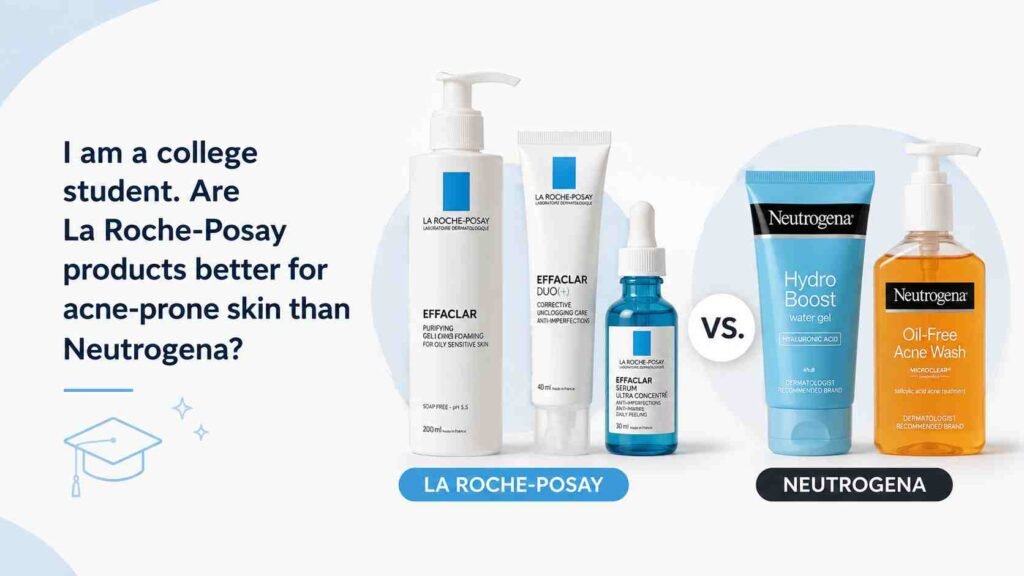

You are a college student. You have acne. You have maybe thirty dollars and no time between classes.
So you searched: are La Roche-Posay products better for acne-prone skin than Neutrogena?
Here is the honest answer, plus a plan you can actually follow.
This guide skips the brand hype. Instead, you will learn which exact products are worth buying, how to match them to your acne, and how to build a routine that fits a dorm budget.
Let’s get into it.
The Short Answer, First
Neither brand is automatically better. The right product depends on your acne type, your skin sensitivity, and your budget.
Here is the rule that cuts through the noise: when two products share the same active ingredient at the same strength, price and tolerance decide the winner. Not the logo.
That means a cheaper bottle can beat a pricier one when the medicine inside is identical.
One more thing before you buy anything. Clear skin takes time.
Most people see real change in 4 to 12 weeks. This is not a guarantee, and it is not overnight.
Do this next: scroll to “Which Products Fit Your Acne Type” and find your acne first. Buy nothing until you know that.
Compare the Ingredient, Not the Brand
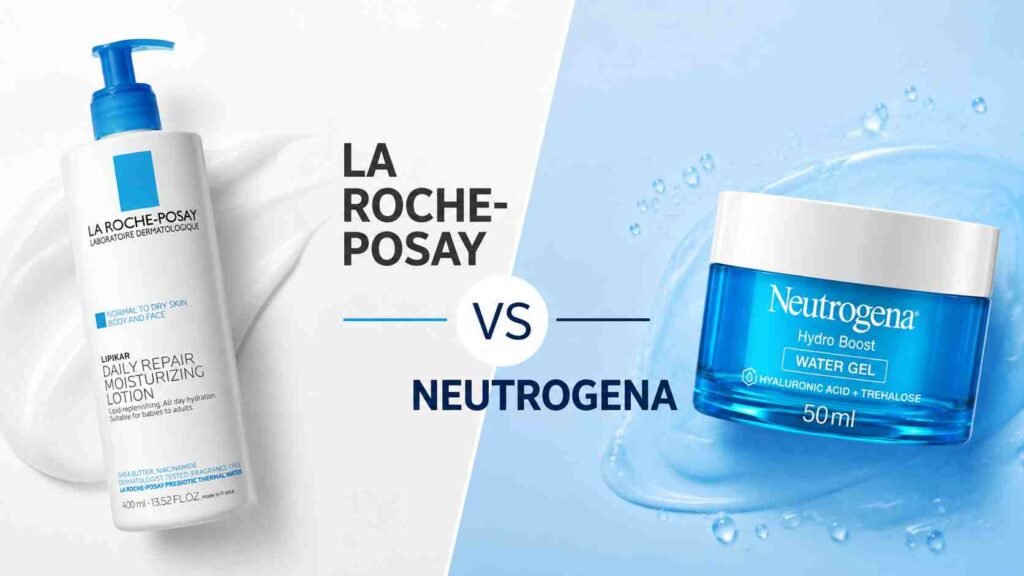
An active ingredient is the part of a product that actually treats your acne. Everything else is texture, scent, and packaging.
Three actives do most of the heavy lifting. Here is what each one does, in plain terms.
- Salicylic acid clears clogged pores. Best for blackheads and whiteheads.
- Benzoyl peroxide kills acne bacteria and calms red, swollen pimples.
- Adapalene is a retinoid. It stops pores from clogging in the first place, so it works best for acne that keeps coming back.
Why does this matter for your wallet? Because a cheaper product with the same active at the same strength usually works just as well.
You do not need a designer bottle to get salicylic acid, in the same way you do not need a name-brand box to get the same medicine inside a generic pill.
Do this next: pick the active that matches your acne from the list above. Write it on your phone. You will use it in the next section.
Product-by-Product Matchups
This is where most articles wave their hands. Let’s compare actual products instead.
One caveat before the tables: ingredient lists change over time. Always check the current label before you buy.
Best Cleanser vs Best Cleanser
Both of these clean your face with the same active at the same strength.
| La Roche-Posay Effaclar Medicated Cleanser | Neutrogena Oil-Free Acne Wash, Fragrance Free | |
|---|---|---|
| Active | 2% salicylic acid | 2% salicylic acid |
| Format | Gel cleanser | Gel cleanser |
| Texture note | Contains menthol; can tingle | Simple, fragrance-free base |
| Rough price | Higher | Lower |
| Who it suits | Skin that likes a cooling feel | Sensitive skin that hates surprises |
Same medicine. The Neutrogena version costs less and skips the menthol. If menthol makes your face sting, that decision is easy.
Best Benzoyl Peroxide Treatment
Here you cannot judge by percentage alone.
| Neutrogena Stubborn Acne 2.5% BP | La Roche-Posay Effaclar 4% BP | |
|---|---|---|
| Active | 2.5% benzoyl peroxide | 4% benzoyl peroxide |
| Format | Leave-on treatment | Wash (rinse-off) |
| Contact time | Stays on skin | Washed off in seconds |
| Rough price | Lower | Higher |
| Who it suits | Targeted, longer contact | Gentle daily exposure |
A leave-on treatment sits on your skin and keeps working. A wash rinses off fast, so a higher number does not mean a stronger effect.
Different jobs. Do not use both at once.
Best Adapalene Gel
This one is close to a tie on purpose.
| La Roche-Posay Adapalene 0.1% | Neutrogena Adapalene 0.1% | |
|---|---|---|
| Active | 0.1% adapalene | 0.1% adapalene |
| Format | Gel | Gel |
| Strength | Identical | Identical |
| Rough price | Higher | Lower |
| Who it suits | Recurring, mixed acne | Recurring, mixed acne |
Same active. Same strength. Buy on price, availability, and which tube you can find in stock.
Best Moisturizer for Acne-Prone Skin
You want lightweight and non-comedogenic. That means it will not clog your pores.
| La Roche-Posay lightweight gel-cream | Neutrogena oil-free gel moisturizer | |
|---|---|---|
| Texture | Light, cushiony | Light, water-gel |
| Comedogenic? | Non-comedogenic | Non-comedogenic |
| Rough price | Higher | Lower |
| Who it suits | Dry-feeling, tight skin | Oily, shine-prone skin |
Acne actives dry you out. A moisturizer is not optional. It keeps your routine comfortable enough to stick with.
Best Sunscreen Pairing
Sunscreen is the step most students skip. Do not.
| La Roche-Posay oil-free SPF | Neutrogena oil-free SPF | |
|---|---|---|
| SPF | 30+ | 30+ |
| Finish | Matte, light | Matte, light |
| Rough price | Higher | Lower |
| Who it suits | Sensitive skin | Everyday budget use |
Do this next: pick one matchup that fits your acne type. Note the cheaper option. That is your first purchase.
Which Products Fit Your Acne Type
“It depends” is a useless answer. Here is the actual decision.
Find yourself below, then grab the matching active.
Choose salicylic acid if you mostly get blackheads and whiteheads. This is comedonal acne. Either brand works, so buy the cheaper one your skin tolerates.
Choose benzoyl peroxide if you get red, swollen, painful pimples. This is inflammatory acne. Start with a low strength and introduce it slowly.
Choose adapalene if your acne keeps returning in the same spots. Adapalene is your prevention tool. Both brands match on strength, so pick on price.
Read the exact label if your skin gets irritated easily. Both brands sell gentle formulas and harsh ones. La Roche-Posay’s Toleriane range is a common gentle starting point, but not every Effaclar product is mild.
Lean Neutrogena if your skin is oily and handles strong actives well. Its oil-control line often gives the best value.
Do this next: write down your acne type and its matching active. One line. Keep it before you read on.
The Best Routine for a Dorm Budget
Stop thinking price-per-product. Start thinking cost-per-routine.
A full routine is four pieces: cleanser, treatment, moisturizer, and sunscreen. Here are three ways to build one.
Routine One: Under-$30 Starter
The bare minimum that still works.
- Wash with a fragrance-free salicylic acid cleanser (Neutrogena).
- Apply a low-strength benzoyl peroxide treatment only if you get red pimples.
- Layer an oil-free gel moisturizer.
- Finish mornings with an SPF 30 sunscreen.
Routine Two: Sensitive Skin
Built to avoid stinging.
- Wash with a plain, gentle, fragrance-free cleanser.
- Apply one carefully chosen leave-on treatment, a few nights a week.
- Layer a soothing, non-comedogenic moisturizer (La Roche-Posay).
- Finish mornings with a sensitive-skin SPF 30.
Routine Three: Best-Value Mix
Save on the basics, spend where comfort matters.
- Wash with a cheaper Neutrogena salicylic acid cleanser.
- Treat with an affordable 0.1% adapalene gel (whichever brand is cheaper).
- Layer a La Roche-Posay moisturizer if cheaper ones leave you tight.
- Finish mornings with any oil-free SPF 30.
Short on cash this month? Buy the treatment that matches your acne first. Add the moisturizer and sunscreen next month.
A few dorm realities. Shared bathroom? Keep products in a small caddy. Busy exam week? A two-step routine of cleanser plus moisturizer beats skipping everything.
Here is the honest caveat. An affordable product used for eight weeks beats an expensive routine you abandon after ten days.
Do this next: pick one routine above. Add up its total cost before you buy a single item.
Mixing Both Brands on Purpose
Acne products are not a loyalty program. You can mix brands, and often you should.
The best routine for you might not be all La Roche-Posay or all Neutrogena. It might be the best-value item from each shelf.
Try these combos:
- Neutrogena benzoyl peroxide treatment paired with a La Roche-Posay moisturizer.
- La Roche-Posay cleanser paired with a Neutrogena adapalene gel.
One hard limit. Never double up on the same strong active.
Using a salicylic acid cleanser, a salicylic toner, benzoyl peroxide, and adapalene all at once will wreck your skin. That is a fast track to raw, peeling, angry skin.
Instead of buying a full four-product lineup from one brand, try picking the cheapest solid option in each category and combining them. The result works the same and costs less.
Do this next: build your routine from single products, not a matching brand set.
How to Start Without Wrecking Your Skin
New actives feel exciting. Slow down.
Follow these steps in order.
- Change one product at a time.
- Patch-test on your jaw for a few days.
- Start at the lowest frequency the label allows.
- Keep the rest of your routine gentle.
- Skip scrubs, harsh toners, and extra exfoliation.
- Increase frequency only when your skin stays comfortable.
Now, a word people confuse constantly. Purging and irritation are not the same.
Purging is a short burst of breakouts in your usual acne spots as a treatment speeds things up. Irritation is burning, redness, and peeling on areas that do not normally break out.
Watch for these signs your routine is too harsh:
- Burning that does not fade
- Redness spreading past the treated area
- Tight or cracked skin
- Heavy flaking or peeling
- New dark marks appearing
More products do not clear acne faster. They usually make it worse.
Do this next: add only one new product this week. Just one.
Sunscreen and Fading Post-Acne Marks
Salicylic acid, benzoyl peroxide, and adapalene all make your skin more sensitive to the sun. That is not a maybe.
So the rule is simple. Daily SPF 30 or higher is non-negotiable when you use acne actives.
Let’s clear up marks, too. Post-acne marks are the dark spots left after a pimple heals. They are not true scars, and most fade over time.
Here is what actually helps them. Preventing new breakouts and wearing sunscreen every day does more for marks than any single “brightening” product.
Sun exposure darkens those spots and slows the fade. Sunscreen protects the progress you are already making.
Both brands sell a solid oil-free daily SPF. Pick whichever fits your budget and feels light enough that you will actually wear it.
One honest limit. Over-the-counter products cannot remove indented or raised scars. Those need a professional.
Do this next: add sunscreen to your morning routine starting tomorrow.
When Neither Brand Is Enough
Sometimes the shelf cannot fix the problem. That is not your fault, and it is not a product failure.
See a dermatologist if you notice any of these:
- Deep, painful cysts or nodules
- Acne that is leaving scars
- Breakouts getting rapidly worse
- Acne linked to hormonal symptoms
- No improvement after weeks of consistent use
- Acne hurting your confidence or mental health
Switching from Neutrogena to La Roche-Posay will not solve these. A dermatologist can.
Good news for students: many campus health centers offer low-cost or free visits. Check yours before you assume you cannot afford help.
Do this next: if two of those signs apply to you, book a visit this week.
The Bottom Line for Students
La Roche-Posay is not universally better than Neutrogena. For most students on a budget, Neutrogena gives you more value.
La Roche-Posay earns its higher price only when a specific formula feels more comfortable and keeps you consistent. Comfort matters, because a routine you enjoy is a routine you finish.
Here is the smartest default for almost any acne-prone student:
- A gentle cleanser
- One evidence-based treatment that matches your acne type
- A non-comedogenic moisturizer
- Daily sunscreen
Mix the brands if that saves you money. Nobody is grading your loyalty.
Do this next: pick one routine from this guide and buy the first product today.
FAQ
Is La Roche-Posay better than Neutrogena for acne?
Not automatically. When both products use the same active at the same strength, your skin’s tolerance and the price decide the winner.
Which is cheaper for a student routine?
Neutrogena usually costs less and is easier to find. It is the better value starting point for most students.
Can I use La Roche-Posay and Neutrogena products together?
Yes. Mix freely, as long as you do not double up on the same strong active in more than one product.
Should I choose salicylic acid or adapalene?
Choose salicylic acid for blackheads and whiteheads. Choose adapalene for acne that keeps coming back in the same spots.
Is Neutrogena too harsh for sensitive acne-prone skin?
Some formulas are, some are not. Reach for fragrance-free options and read the label instead of judging the whole brand.
How long before an acne product works?
Expect 4 to 12 weeks for real change. Take a photo every two weeks so you can see progress you might miss day to day.
Which brand is better for post-acne marks?
Neither wins on its own. Daily sunscreen and preventing new breakouts do the most to fade dark spots.
Can I use an acne cleanser twice a day?
Often yes, but start once daily. If your skin feels tight or dry, cut back and use a gentle cleanser for the second wash.