
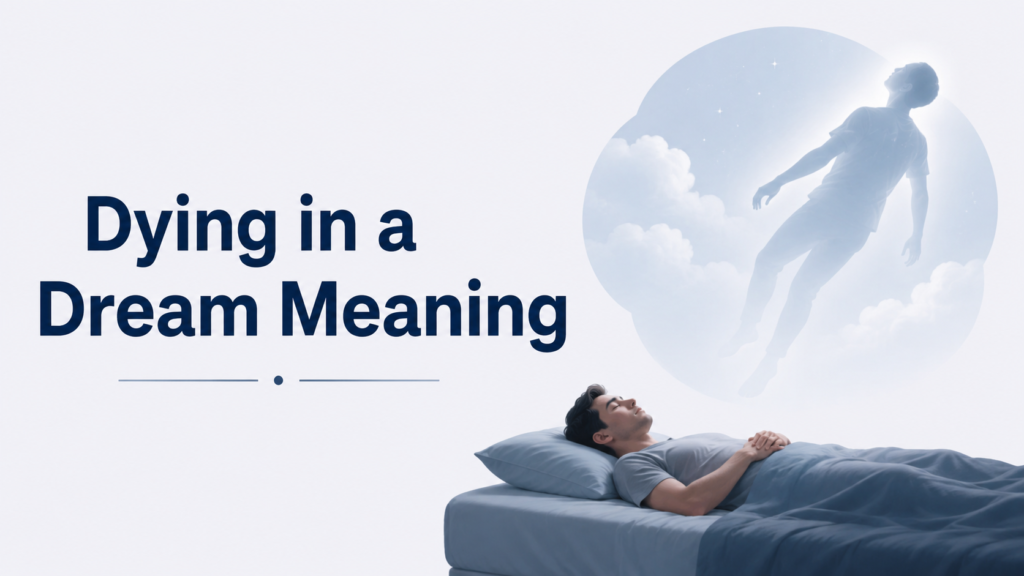

You woke up gasping. Heart pounding. Maybe you even reached for your phone in the dark just to feel real again.
And now you’re here, typing “dying in dream meaning” with a knot in your stomach.
First things first: you’re okay.
A dream about dying can feel more real than almost any other dream. Your brain doesn’t hand you a warning label saying “this isn’t real.” So when it happens, it lands hard.
But here’s the reassurance you came for, right up front.
Dreaming about dying does not predict real death. It is not a countdown. It is not a bad omen ticking over your head.
In this guide, we’ll walk through what these dreams usually mean, what each specific scenario points to, and what the feeling inside the dream is trying to tell you.
By the end, you’ll be able to read your own dream — calmly, and on your own terms.
Why You Woke Up Shaken — and Why That’s Normal
Let’s name it plainly. Dying in a dream is terrifying in the moment.
You might have felt the fall. The stab. The car spinning. Or maybe you just quietly knew, “I’m dead now,” and that stillness rattled you even more.
That physical reaction — the racing heart, the sweat, the confusion — is completely normal.
Your body doesn’t fully separate a vivid dream from a real threat while you’re asleep. It reacts as if you’re actually in danger. So you wake up in survival mode.
That’s biology. Not prophecy.
Here’s what a lot of people quietly worry: “Was that a sign? Am I going to die?”
No. There’s no evidence that dying in a dream forecasts anything about your real lifespan.
So take a breath. The scary part is already over. Now we get to the interesting part — what your mind was actually working through.
What Dying in a Dream Usually Means
Most people assume death means loss. An ending. Something taken away.
In dreams, it’s usually the opposite.
Dying in a dream most often points to transformation. Not a literal ending — a turning point.
Think of it as your mind closing one chapter so another can begin.
Something in your waking life is shifting. Ending. Being outgrown. And your subconscious reaches for the biggest symbol it has to represent a big change: death.
Picture someone who just handed in their two weeks’ notice. For a decade, they were “the reliable one at the company.” That role is dying. So the dream shows it the only way dreams know how — dramatically.
The change is real. The death is symbolic.
One honest note, though. Transformation is the common meaning, not the only one. Context always decides.
That’s why the rest of this guide focuses on your specific dream — not a one-size-fits-all answer.
Dying in a Dream Meaning by Scenario
The details matter here. How you died in the dream changes the message completely.
Find the version that matches yours.
You die peacefully.
This often points to acceptance and closure. You may be ready to let something go, even if you haven’t said it out loud yet. A calm death dream is rarely a bad sign.
You die violently.
Being stabbed, shot, or crushed feels awful. But it usually reflects the emotional intensity of a change you didn’t choose — a layoff, a breakup, a diagnosis — not a real threat coming for you.
You know you’re dying in the dream.
That conscious awareness often mirrors a part of you that already knows something is ending. You feel the shift happening. The dream is catching up to what you sense.
You suddenly discover you’re already dead.
This can point to a change that happened while you weren’t fully paying attention. You “wake up” to it. Like realizing a friendship faded months ago and you’re only now noticing the silence.
You die and keep watching the dream.
Floating above the scene? Observing calmly? This often reflects watching your own transition from a safe distance — processing a change without being overwhelmed by it.
You die and come back to life.
This is one of the most hopeful versions. It tends to signal rebirth, a second chance, or recovery after a rough stretch. Think of someone finishing a hard year and finally feeling like themselves again.
You attend your own funeral.
This one sounds grim, but it’s usually about perspective. You may be reflecting on how others see you — or quietly saying goodbye to a role you’re leaving behind.
Someone else dies in your dream.
When it’s not you, ask what that person represents. A changing relationship. Or a trait they carry — confidence, control, patience — that’s shifting inside you.
A loved one who is still alive dies.
This is the one that scares people most. Take a breath. It usually reflects a fear of losing them, or a change in that bond. It’s about your feelings — not a premonition.
Notice how none of these mean “you’re about to die.” Every version points inward, toward something you’re feeling or moving through.
What the Feeling in the Dream Reveals
Here’s a shift that changes everything.
The how of the death matters less than how it felt.
Two people can have the exact same dream — dying in a car crash — and walk away with opposite meanings. Why? Because one felt terror and the other felt calm.
Your strongest emotion is the real clue. Match yours below.
- Fear → overwhelm, a loss of control, or something you’re actively avoiding.
- Relief → a burden you’re ready to set down, or exhaustion with a role you’re tired of playing.
- Peace → acceptance, emotional closure, a quiet readiness for what’s next.
- Confusion → an unclear or unfinished change you haven’t made sense of yet.
- Sadness → grief, deep attachment, or fear of separation.
- Numbness → burnout or emotional shutdown, where you’ve stopped feeling to cope.
Say you’re a new parent running on three hours of sleep. You dream you die, and instead of panic, you feel… relief.
That’s not disturbing. That’s honest. Part of you is craving rest and a break from constant responsibility. The dream just said it plainly.
Trust the feeling. It usually knows before you do.
The “Death” of an Old Version of You
Here’s the angle most articles skip.
Dying in a dream often isn’t about a life event. It’s about an identity ending.
A version of you is dying so a new one can step forward.
This shows up during specific life moments. See if any of these match your last few months:
- Becoming a parent
- Starting or leaving a job
- Ending a relationship
- Moving to a new city
- Recovering from an illness
- Outgrowing a belief system or friend group
- Stepping into a new life stage
Take the breakup example. For two years, you were “half of us.” That identity had a whole shape — routines, plans, a shared future.
When it ends, that self genuinely dies. And your mind marks the moment.
Or think about the person who just became a mom. The carefree, sleep-in-on-Saturdays version of her is gone. Not lost — evolved. But the goodbye is real.
That’s what the dream honors. The old you making room for the next you.
There’s something freeing in that, once you see it.
Symbolic Dream or Stress Dream? How to Tell
Now for some honesty. Not every dream of dying carries deep meaning.
Sometimes a dream is just your brain blowing off steam.
Overhyping every dream isn’t helpful. So here’s how to tell the two apart.
A symbolic dream tends to:
- Tie clearly to a real transition in your life
- Feel vivid and emotionally sharp
- Leave you with a clear feeling you can name
A stress dream tends to:
- Show up during poor sleep, anxiety, or grief
- Feel chaotic, messy, or random
- Repeat in a jumbled, exhausting way
Common non-symbolic causes are worth knowing, too. Sleep disruption. Acute stress. Grief you’re still processing. Health anxiety after a scary doctor’s visit.
If you’ve been doom-scrolling until 2 a.m. for a week, your death dream might just be your overtired brain — not a profound message.
Either way, relax. Both types are completely normal. Neither one means real danger.
How to Interpret Your Own Dream About Dying
Ready to decode yours? You don’t need an app or a dream dictionary.
You just need six questions. Move through them slowly.
- Who died? You, a version of you, or someone else?
- How did the death happen? Peaceful, sudden, violent, or repeated?
- What emotion was strongest? Name the one feeling that lingered.
- What in your waking life feels like it’s ending or changing? Be specific.
- What part of your identity feels threatened — or ready to grow?
- Did the dream end at death, or keep going?
Let’s test it fast with a real example.
You dreamed you died peacefully in an old house. You felt calm. You’ve just accepted a job in another state.
Run the questions: You died. Peacefully. You felt calm. You’re moving. Your “hometown self” is ending. And the dream felt settled.
Read together, the message is clear. You’re at peace with leaving. A chapter is closing, and part of you already knows you’re ready.
That’s it. That’s the whole method.
The best part? You can use these six questions for any death dream you ever have — not just this one.
When Dreams About Dying May Be Worth Talking About
Let’s be clear. The vast majority of death dreams are harmless. A one-off dream is nothing to worry about.
But sometimes a pattern is worth paying attention to.
Keep a gentle eye out for these:
- Recurring nightmares that won’t stop
- Avoiding sleep because you’re afraid of the dreams
- Waking up in panic on a regular basis
- Recent trauma or the loss of someone close
- Death fears creeping into your daytime thoughts
- Anxiety or low mood that keeps getting heavier
If a few of those ring true, it might be worth talking to a therapist or a sleep professional.
This isn’t a reason to panic. It’s just good self-care.
Reaching out for support isn’t weakness. It’s you taking your own well-being seriously. That’s strength.
Common Myths About Dying in a Dream
A lot of scary “facts” float around online. Let’s clear the biggest ones.
Myth: Dying in a dream predicts real death.
Fact: There’s no evidence for this at all. You can die in a dream and wake up perfectly fine — millions of people do.
Myth: It always means transformation.
Fact: Not always. It can also reflect stress, grief, or plain burnout. Context matters more than a single rule.
Myth: A violent dream death means something bad is coming.
Fact: Violence usually mirrors emotional intensity, not a future event. Big change can feel brutal, and the dream reflects that feeling.
Myth: A peaceful death dream is a bad omen.
Fact: The opposite, usually. Calm often signals acceptance, closure, and readiness for what’s next.
See the pattern? Almost every myth points outward at fate. The truth points inward at you.
The Bottom Line
So, what does dying in a dream mean?
Rarely death. Almost always change.
It’s your mind’s way of marking a turning point — a role ending, an identity shifting, a chapter quietly closing so a new one can open.
You now have everything you need to read it. Look at the scenario. Name the feeling. Connect it to what’s changing in your life.
The dream that shook you awake wasn’t a threat.
It was a message. And you just learned how to understand it.