
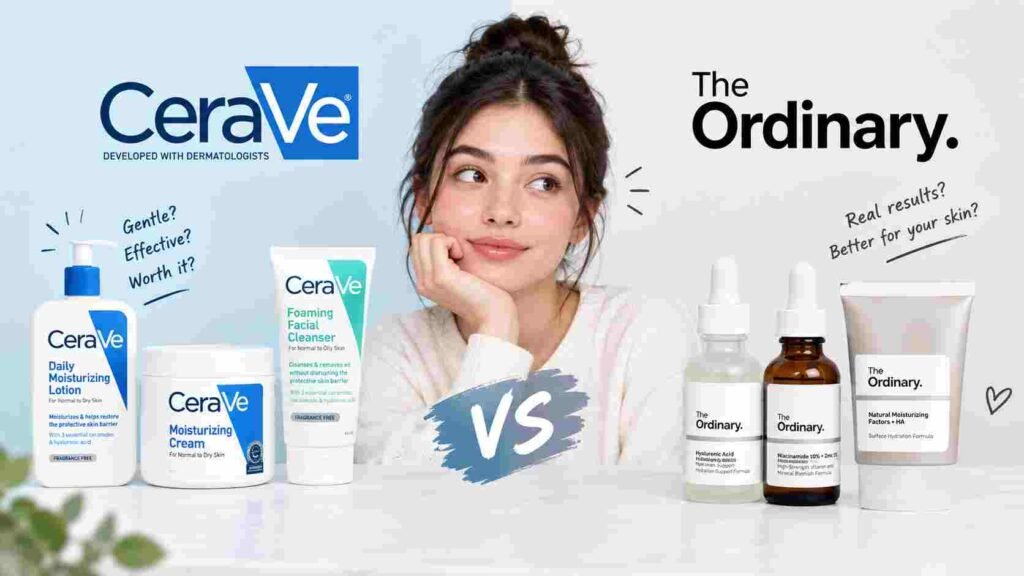

You have seen both brands on your feed. CeraVe and The Ordinary show up in every “what’s in my routine” video, and both cost less than a takeout order.
So how does CeraVe compare to The Ordinary in terms of skincare effectiveness? Here is the short version: CeraVe protects your skin, and The Ordinary treats it.
That one line explains almost everything about how these two brands work.
Most articles stop at “it depends.” This one gives you a clear answer for your skin, your budget, and your concerns. Read to the end and you will know exactly which one to buy first.
What “Skincare Effectiveness” Actually Means
Effectiveness is not just about which product is stronger. A product is effective when it gives you real results without wrecking your skin or your wallet.
Break it into five plain parts. Keep these in mind as you read.
- Does it give the result you want? A serum that fades dark spots is only useful if dark spots are your goal.
- Can your skin tolerate it? A strong acid that leaves you red and peeling is not working for you, no matter how powerful it is.
- Will you actually keep using it? The best product is the one you reach for every day, not the one that sits in a drawer.
- Does the cost match the result? Cheap means nothing if you need five extra products to make it work.
- Does it fit your skin goal? Matching the product to your actual concern beats buying whatever went viral last week.
Think of it like a workout. The best routine is the one you stick to, not the hardest one you quit after a week.
Keep these five checks in mind as you read the rest.
Read Also: I Have Sensitive Skin. How Gentle Are Nivea’s Creams Compared to Aveeno?

CeraVe vs The Ordinary: Two Different Jobs
These brands are not really rivals. They do different jobs.
CeraVe is barrier-first. It is built to repair and protect your skin. Every core product leans on three ceramides, hyaluronic acid, and niacinamide, plus a slow-release tech called MVE that keeps working through the day.
The Ordinary is active-first. It sells single, high-strength ingredients with the exact percentage printed on the label. When a bottle says “Niacinamide 10% + Zinc 1%,” you know precisely what you are putting on your face.
Here is the plain difference. CeraVe keeps your skin healthy so it can do its job. The Ordinary pushes your skin toward one specific change.
Both are drugstore-priced and backed by real science. That combination is exactly why they blew up with Gen Z.
| Factor | CeraVe | The Ordinary |
|---|---|---|
| Main goal | Barrier repair | Targeted treatment |
| Best for | Everyday care | Fixing one concern |
| Learning curve | Very low | Steeper |
| Results speed | Days | 4–12 weeks |
| Irritation risk | Low | Higher with strong actives |
Which Is More Effective by Skin Concern
This is the part that matters most. Find your concern, read the winner, and skip the rest if you want.
Acne and Breakouts
Winner: The Ordinary.
For active treatment, The Ordinary wins. Its Salicylic Acid 2% Solution clears clogged pores, and Niacinamide 10% + Zinc 1% helps control oil and calm redness. You get real acne actives for under $15 combined.
CeraVe still plays a role. Its non-comedogenic cleansers and moisturizers support healing without clogging you up.
One honest note: actives take 4 to 12 weeks. This is not an overnight fix, so give it time before you judge it.
Dryness and Dehydration
Winner: CeraVe.
Dry, flaky skin needs its barrier rebuilt, and that is CeraVe’s whole job. The Moisturizing Cream pairs ceramides with cholesterol to mimic your skin’s own structure. Hyaluronic acid alone cannot do that.
The Ordinary can support here. Its Hyaluronic Acid 2% + B5 or Natural Moisturizing Factors + HA add a hydration layer. But use them on top of a CeraVe base, not instead of one.
Oily Skin
This one splits.
Reach for CeraVe for a light cleanser and oil-free hydration, like the Foaming Facial Cleanser. Reach for The Ordinary for oil control, with Niacinamide 10% + Zinc 1% doing the heavy lifting.
Remember this: oily skin can still be dehydrated. Do not skip moisturizer just because you shine by noon.
Sensitive and Reactive Skin
Winner: CeraVe.
If your skin flares easily, CeraVe is the safer pick. Its formulas are fragrance-free and gentle, and the brand holds the most National Eczema Association seals of any skincare line.
The Ordinary can work, but stick to the gentle options. Start with B5 or plain hyaluronic acid, and avoid strong acids early on.
Dark Spots and Uneven Tone
Winner: The Ordinary.
For fading dark spots, The Ordinary has the tools. Azelaic Acid 10%, Alpha Arbutin, vitamin C, and niacinamide all target uneven tone directly. CeraVe’s barrier-focused lineup is not built for this.
One caveat you cannot ignore: results take weeks, and daily SPF is non-negotiable. Skip sunscreen and your dark spots come right back.
Texture and Pores
Winner: The Ordinary.
For fast change, The Ordinary moves quicker. The AHA 30% + BHA 2% Peeling Solution visibly smooths rough skin, and its retinoids refine texture over time.
CeraVe offers a gentler path. Its SA Cleanser exfoliates slowly if strong acids are too much for you.
Safety flag: that 30% peel is a weekly, 10-minute treatment. Leave it on too long and it can burn. Respect the timer.
Barrier Repair
Winner: CeraVe, clearly.
A damaged barrier feels tight, stings, turns red, or flakes. When that happens, CeraVe is what you want.
Here is the rule most people miss. Fix the barrier first, then add actives. Piling acids onto damaged skin only makes it worse.
Before you move on, pick your top one or two concerns. That choice decides your whole routine.
Which Is Better if You’re a Beginner
Winner: CeraVe.
CeraVe is hard to misuse. That alone makes it the better starting point when you are new.
The Ordinary rewards you later, once you understand what each active does. Starting with a 30% peel or three serums at once is exactly how beginners wreck their skin.
Here is a starter routine you can copy today:
- Wash with CeraVe Hydrating Cleanser.
- Apply CeraVe Moisturizing Cream.
- Finish with CeraVe AM SPF 30 Facial Moisturizing Lotion in the morning.
Three steps. That is a complete, effective routine. Try it tonight.
Which Gives You More for Your Money
Price tags do not tell the full story. Value depends on what you are buying.
CeraVe wins on daily basics. A 16oz cleanser or a big tub of Moisturizing Cream costs around $16 and lasts months. Cheaper per ounce, and you replace it far less often.
The Ordinary wins on cost-per-active. A $6 to $10 serum targets one thing well, and that is remarkable for the price.
Here is the hidden cost people forget. A cheap single active often needs supporting products to work safely. So the “cheaper” bottle is not always cheaper once you add everything up.
The smart verdict: use CeraVe for your foundation, and The Ordinary for treatments.
Where Each Brand Can Backfire
Nobody talks about this honestly, so let’s fix that.
The Ordinary can backfire fast if you rush. Watch for these mistakes:
- Over-exfoliating with acids strips your barrier and leaves you raw.
- Layering too many actives at once triggers stinging and redness.
- Starting retinoids too strong causes peeling and irritation in the first weeks.
Learn the difference between purging and a reaction. Purging happens where you usually break out and fades over a few weeks. A reaction shows up as stinging, burning, or redness in new places, and it means stop.
CeraVe has downsides too. Results build slowly, and the tub Moisturizing Cream can feel heavy on oily skin.
The safest rule: introduce one new active at a time, then wait two weeks.
If your skin is stinging right now, stop all actives. Use only a gentle cleanser and CeraVe Moisturizing Cream until your skin calms down.
Best Product Matchups
Brand comparisons are useful, but you buy products, not brands. Here are the head-to-head pairs that matter.
Gentle cleanser: CeraVe Hydrating Cleanser vs The Ordinary Squalane Cleanser. Pick the CeraVe one first. It suits almost every skin type and works morning and night.
Exfoliating cleanser: CeraVe SA Cleanser vs The Ordinary Salicylic Acid 2% Solution. Choose the CeraVe SA Cleanser if you want gentle daily use. Choose the Salicylic Acid 2% for stronger, targeted spot treatment.
Moisturizer: CeraVe PM Facial Moisturizing Lotion vs The Ordinary Natural Moisturizing Factors + HA. Both are lightweight, but the CeraVe PM adds niacinamide and ceramides, so start there.
Hydrating serum: CeraVe Hydrating Hyaluronic Acid Serum vs The Ordinary Hyaluronic Acid 2% + B5. The Ordinary version costs less and does the job well. Pick it if budget is tight.
Retinoid: CeraVe Resurfacing Retinol Serum vs The Ordinary Retinol 0.2% in Squalane. Beginners should start with the low-strength Ordinary retinol, then move up slowly.
Can You Use CeraVe and The Ordinary Together?
Yes. For most people, this is the best move.
They complement each other perfectly. CeraVe builds your base, and The Ordinary targets your concern. You get everyday protection plus focused treatment.
Follow one order rule. Apply The Ordinary’s active to clean skin first, then seal it in with a CeraVe moisturizer. And add only one active at a time.
Here is a simple morning routine:
- Wash with CeraVe Hydrating Cleanser.
- Apply The Ordinary vitamin C (optional).
- Finish with CeraVe AM SPF 30 Lotion.
And an evening routine:
- Wash with CeraVe Foaming or Hydrating Cleanser.
- Apply one active, starting with The Ordinary Niacinamide 10% + Zinc 1%.
- Seal with CeraVe PM Facial Moisturizing Lotion.
Start the morning routine tomorrow. Add one evening active next week, not before.
Final Verdict — Which One Should You Pick?
Neither brand is “better.” They do different jobs. Here is your answer by profile.
- Total beginner: Start with CeraVe. Master three steps first.
- Acne-prone: Use The Ordinary actives on a CeraVe base.
- Dry or sensitive skin: Go with CeraVe first.
- Barrier damaged from over-exfoliating: Use CeraVe only until your skin heals.
- Dark spots or texture goals: Choose The Ordinary, plus daily SPF.
- Wants the fewest products: Stick with CeraVe and three steps.
The honest bottom line: most Gen Z women get their best skin using both. CeraVe protects, The Ordinary treats, and together they cover almost everything under a drugstore budget.
Pick your profile above. Buy that first product this week.
Frequently Asked Questions
Is CeraVe better than The Ordinary for beginners?
Yes. CeraVe’s fragrance-free, gentle formulas are nearly impossible to misuse. The Ordinary’s high-strength actives, like the 30% peel, need more knowledge to use safely.
Is The Ordinary more effective than CeraVe?
For treating acne, dark spots, and texture, yes. For barrier repair, hydration, and sensitive skin, CeraVe wins. They excel at different jobs.
Can I use CeraVe and The Ordinary together?
Absolutely. Use CeraVe to cleanse and moisturize, and The Ordinary for targeted actives. Apply the active first, then seal with a CeraVe moisturizer.
Which is better for acne-prone skin?
The Ordinary. Its Salicylic Acid 2% and Niacinamide 10% + Zinc 1% target breakouts and oil directly, for under $15 combined.
Which is better for dark spots?
The Ordinary. Azelaic Acid, Alpha Arbutin, and vitamin C fade uneven tone. Results take weeks, and daily SPF is essential.
Is The Ordinary safe for sensitive skin?
It can be, if you stick to gentle picks like Hyaluronic Acid 2% + B5. For reactive or eczema-prone skin, CeraVe holds the edge.