
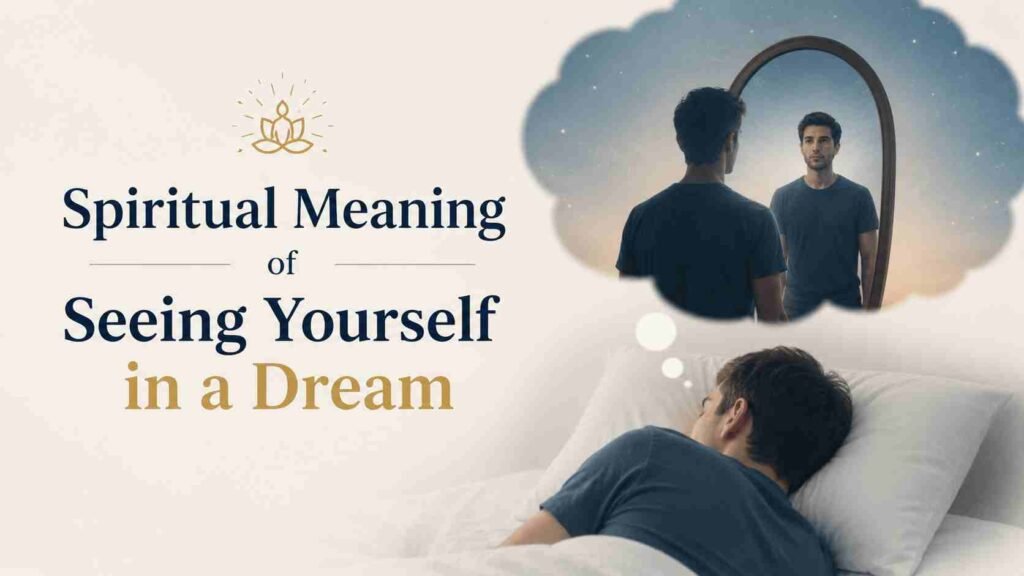

You wake up feeling unsettled. In the dream, you weren’t just yourself — you were watching yourself from the outside, like a stranger in your own story.
Maybe you caught your reflection in a mirror. Maybe there were two of you in the same room. And now, coffee in hand, you’re still trying to shake the feeling.
Here’s the thing — you’re not losing your mind. And it’s not a bad omen.
The spiritual meaning of seeing yourself in a dream usually comes down to one core message: a part of you is asking to be seen.
This dream tends to surface during periods of change, inner questioning, or quiet shifts you haven’t fully processed. It’s your psyche tapping you on the shoulder.
What makes this guide different? The meaning depends on which version of you showed up and how you felt — the piece most articles skip entirely.
We’ll walk through the core spiritual meaning, whether it’s good or bad, specific scenarios, what your emotions were signaling, the psychology angle, and real next steps.
Let’s get into it.
What Does It Mean to See Yourself in a Dream Spiritually?
At its core, this dream is your soul or your subconscious, whichever frame fits you better asking you to be honest with yourself.
Not the curated version. Not the persona you hold together for everyone else. The actual you, right now, in this season of life.
Spiritually, these dreams tend to orbit a few consistent themes: self-awareness, soul growth, alignment with your true path, and messages from your higher self. If that last phrase feels abstract, try thinking of your higher self as the calm, clear part of you that already knows what you need — the inner voice you tend to ignore when things get busy or loud.
There’s also a concept worth knowing: the “observer self.”
When you watch yourself in a dream as though you’re sitting in a cinema watching your own film, that emotional distance isn’t random. It usually means you need to step back and see your life from the outside — the patterns, the habits, the things you’ve been too close to notice.
Think of this dream as a mirror moment from within. Your mind is handing you an unfiltered snapshot — no performance, no filter, no version crafted for someone else. Just you, as you actually are.
That’s a gift. Even when it doesn’t feel like one.
If you want to dig deeper into this kind of inner guidance, reading more about connecting with your higher self is a genuinely worthwhile next step.
Read Also: 10 Shocking Spiritual Meaning of a Shooting Star: Signs & Symbolism

Is Seeing Yourself in a Dream Good or Bad?
Let’s cut straight to it: it’s not automatically good or bad. I know that’s not the dramatic verdict some people are hoping for, but it’s the truthful one.
The meaning really depends on three things — the version of yourself you saw, the emotion you felt during the dream, and the current season of your waking life. Two people can have nearly identical dreams and walk away with completely different messages.
Here’s a quick reference to keep handy:
- Peaceful dream → you’re moving toward alignment, self-acceptance, or a more honest relationship with yourself.
- Unsettling dream → there’s likely a truth you’ve been sidestepping, or stress that needs a real look.
Now let me flag one misunderstanding that causes unnecessary panic.
People often wake up alarmed after seeing themselves crying, injured, or even “dead” in a dream — assuming something terrible is coming. It almost never means that. Those images almost always represent endings, release, and transformation. An old version of you stepping aside to make room for who you’re becoming. That’s not catastrophe — that’s growth.
Spiritual Meaning Based on How You Saw Yourself
This is where things get genuinely useful. Instead of one blanket answer, let’s match the meaning to exactly what you witnessed in your dream.
Find the scenario that fits.
Seeing Yourself in a Mirror in a Dream
A mirror in a dream speaks directly to self-perception, identity, and truth. It’s your mind holding up a question: “How do I actually see myself right now?”
The details tell you a lot.
A clear, steady reflection usually means clarity — you feel settled and secure in who you are. A blurry, distorted, or cracked reflection points to confusion, or a self-image that’s taken some damage lately — maybe after a hard conversation, a rejection, or a rough few months.
If mirrors keep appearing in your dreams, it’s worth spending some time on what mirrors symbolize spiritually — there’s more to unpack there.
Seeing Two Versions of Yourself (The Double / Split Self)
Seeing two of yourself in a dream can feel genuinely unsettling, but the meaning is one of the most fascinating in the whole field of dream interpretation.
It typically represents split-identity symbolism — the self you present to the world versus the self you keep tucked away.
Here’s a real-life example: imagine someone torn between a safe corporate job and a creative path they’ve quietly dreamed about for years. Their dream hands them two versions of themselves standing side by side — one in a suit, one in paint-stained clothes. Both are real. Both are them.
The dream isn’t asking you to pick one and ditch the other. It’s an invitation to integrate — to build something that lets both sides of you actually exist.
Seeing Your Older Self
When your older self appears in a dream, you’re essentially getting a visit from your future self — wiser, calmer, with the benefit of perspective you don’t have yet.
This one shows up a lot during uncertainty or big transitions.
Picture someone six months into a career change, second-guessing everything. They dream of themselves at 65, sitting on a porch, looking at peace. They wake up feeling oddly reassured — not because the dream promised success, but because their future self seemed okay.
That’s the dream telling you: You’re heading somewhere real. Keep going.
Seeing Your Younger Self or a Child Version of You
Dreaming of a younger you — sometimes a child, sometimes a teenager — usually points toward inner child healing. It’s often about unresolved memories surfacing, or a need to reconnect with a lighter, freer version of yourself that got buried somewhere under adult pressure.
Try sitting with this question: What did that younger me need that I can actually give myself now?
Maybe it’s rest without guilt. Maybe it’s permission to play, create, or just be silly without explaining yourself. That question can open something unexpected — and reconnecting with your inner child is a genuinely powerful thread to follow.
Seeing Yourself From Outside Your Body
Watching yourself from the outside is your mind pulling the camera back — giving you the wide shot when you’ve been too zoomed in to see clearly.
This tends to happen when you’re so deep inside a situation that you’ve lost perspective on it.
Think of someone who’s been running on empty for months — working late, skipping meals, telling themselves they’re fine. They dream of watching themselves hunched over a desk at midnight, and for the first time, they actually feel how bad it’s gotten. Not as a thought. As a feeling.
That’s the whole point of the perspective shift.
A gentle note: this kind of out-of-body dream experience is reflective and spiritual in nature — not the same as any clinical dissociation. Don’t pathologize it. Just take the invitation to step back and honestly observe your patterns.
The Shadow Self — Seeing a Darker or Unfamiliar Version of You
This is the one almost every article skips, which is a real missed opportunity — because it’s one of the richest dream experiences you can have.
The shadow self represents the parts of you that you suppress, deny, or feel a quiet shame about. Anger. Jealousy. Ambition. Desire. Whatever you’ve learned — through childhood, through social conditioning, through fear — to keep hidden.
Here’s a concrete example: someone who’s always been the “easygoing one” in every relationship — never complains, never pushes back, always accommodates. They dream of a cold, expressionless version of themselves staring them down. That dark figure? That’s the frustration and resentment they’ve never let themselves feel, let alone express.
The dream isn’t a warning. It’s a knock at the door.
Your shadow isn’t your enemy. It’s the disowned part of you asking to be welcomed back in — acknowledged, not feared. If this section landed for you, learning more about shadow work will be worth your time.
What Your Emotions in the Dream Reveal
Here’s a rule that will genuinely change how you read dreams going forward: the emotion is the first clue. The imagery is the second.
What you felt in the dream usually carries more meaning than what you saw. So before you start dissecting the symbolism, ask yourself what emotion hit hardest.
Match yours below, and use the self-reflection prompt to go a level deeper:
- Peace → self-acceptance and alignment. Ask: Where in my life am I finally feeling at home in myself?
- Fear → identity conflict, or a truth you’re not ready to face. Ask: What am I scared to admit right now?
- Confusion → you’re between chapters, in an in-between space. Ask: What decision am I still avoiding?
- Sadness → grief for an old self, or an emotion you haven’t let yourself process. Ask: What am I quietly letting go of?
- Empowerment → spiritual growth; you’re reclaiming something that belongs to you. Ask: What strength am I finally ready to own?
- Shame → your shadow self rising, asking for compassion rather than judgment. Ask: What part of me do I keep punishing that just needs acceptance?
Sit with the one that resonates. That’s almost always where the real message is hiding.
Spiritual Meaning vs. Psychological Meaning
A question I hear often: “Is this a spiritual sign, or is my brain just doing weird things at night?”
The answer — and this is the honest one — is that it doesn’t have to be either-or.
Here’s how the two lenses sit side by side:
- Spiritual view: a message from your higher self, a nudge toward soul growth, a moment of spiritual awakening, shadow integration, or divine guidance.
- Psychological view: your mind processing identity, sorting through stress, running emotional maintenance, and filing experiences from waking life into longer-term understanding.
Look at those two lists. They’re not in conflict.
A dream can be your brain doing necessary emotional work and a meaningful spiritual experience at exactly the same time. The subconscious and the soul aren’t competing — they’re often pointing at the same thing from different angles.
If you want to track patterns and notice what keeps coming up, keeping a dream journal is the most practical tool available. Even jotting a few lines every morning reveals recurring themes faster than you’d expect.
Is Your Dream a Warning, Awakening, or Healing?
Most dreams about yourself fall into one of three categories. Learn these, and you’ll interpret your dreams with a lot more clarity and a lot less anxiety.
Awakening → You’re waking up to a truth and stepping into a more authentic version of yourself. These dreams feel clarifying — sometimes even electric. There’s often a sense of recognition, like something finally clicked.
Healing → You’re integrating old pain, releasing a worn-out identity, or making peace with your past. These dreams tend to feel tender or emotional — like something inside you quietly exhaled after holding its breath for a long time.
Warning → You’re living out of alignment with what you actually need — ignoring your gut, repeating a harmful pattern, or staying somewhere you’ve already outgrown. These feel tense, urgent, or hollow. Like a tug that won’t quit.
How do you tell which applies to you? Pay attention to the overall tone of the dream alongside what’s happening in your waking life.
Calm and illuminating usually signals awakening. Emotional and releasing points to healing. Tense and repetitive almost always leans toward warning.
If your dream felt like an awakening, you might start recognizing other signs of a spiritual awakening already showing up in your day-to-day life — it’s worth a look.
How to Interpret Your Own Dream (5 Questions)
You don’t need a professional dream analyst to figure this out. You just need the right questions — asked in the right order.
Grab a notebook and answer these while the dream is still fresh:
- What version of yourself did you see? (Older, younger, mirrored, doubled, shadowed, out-of-body?)
- What emotion did you feel first? (Not what you think you should have felt — what actually hit you before you had time to think.)
- Were you observing yourself or actively interacting with yourself?
- What’s currently changing in your waking life?
- Did the dream feel like reflection, warning, healing, or awakening?
One thing that makes a bigger difference than people expect: write down the emotion before you write down the imagery.
Your feelings are the compass. The symbolism is just the map they’re drawn on.
What to Do After Dreaming About Yourself
Here’s the bottom line: the spiritual meaning of seeing yourself in a dream always comes back to three things — the version of you that appeared, the emotion you felt, and the season of life you’re in right now.
Get clear on all three, and the message becomes a lot less mysterious.
Here’s your simple action checklist:
- Journal the specific version of yourself you saw — older, younger, shadowed, doubled — while the details are still clear.
- Write the emotion down first, the imagery second. Don’t skip this step.
- Connect the dream to something shifting in your life — a relationship, a career move, an identity transition.
- Identify where you feel out of alignment — the thing you know isn’t working but haven’t fully addressed.
- Ask what part of you is asking for attention right now. Then actually listen.
And through all of this — be gentle with yourself.
This dream isn’t here to frighten you or deliver some ominous verdict on your life. It’s here to help you know yourself a little more honestly.
That’s always worth paying attention to.
Frequently Asked Questions
What does it mean if you see yourself in your own dream?
It usually means a part of you is asking for your attention. Seeing yourself in a dream often points to self-reflection, personal change, or a message from your higher self. The version of you that appeared and the emotion you felt will shape the exact meaning — so notice both before drawing any conclusions.
Is it good or bad to see yourself in a dream?
Neither, on its own. A peaceful dream tends to signal alignment and self-acceptance. An unsettling one often points to stress or a truth you haven’t faced yet. It’s not a bad omen — think of it as a mirror. What matters most is how the dream felt and what’s currently shifting in your life.
What does it mean to see two of yourself in a dream?
It typically reflects split-identity symbolism — the version of you the world sees versus the version you keep hidden. It tends to show up during inner conflict or at a major crossroads. The invitation isn’t to choose one side and discard the other — it’s to integrate both into something more whole and honest.
Why do I keep seeing myself in my dreams?
Recurring self-dreams usually signal an unresolved theme still asking for your attention — often tied to ongoing change, unprocessed stress, or personal growth you’re in the middle of. Your subconscious repeats what hasn’t been fully faced yet.